The call usually comes a few days after the crash. The adjuster says the car's a total loss, reads you a number and asks where to send the paperwork. It sounds final. It isn't. It's an opening offer, and the documents behind it are yours to ask for.
More people are getting this call than ever. CCC Intelligent Solutions, a claims technology company that tracks the repair business, reports that 23.1% of auto claims in 2025 ended as total losses, the highest share it's recorded. Repair costs have climbed, the average car on the road is nearly 13 years old, and an older car doesn't need much damage before fixing it costs more than it's worth.
What the insurer owes you on a totaled car is its actual cash value: what your car, with its mileage, options and condition, would have sold for in your area just before the crash. Almost no adjuster works that out by hand. The number comes from a valuation report built by third-party software, which pulls a few "comparable" vehicles from dealer listings, adjusts each one up or down for mileage and equipment, gives your car a condition score and averages the results. How that software trims prices has been the subject of class-action suits, and two of them settled for $48 million and $43 million.
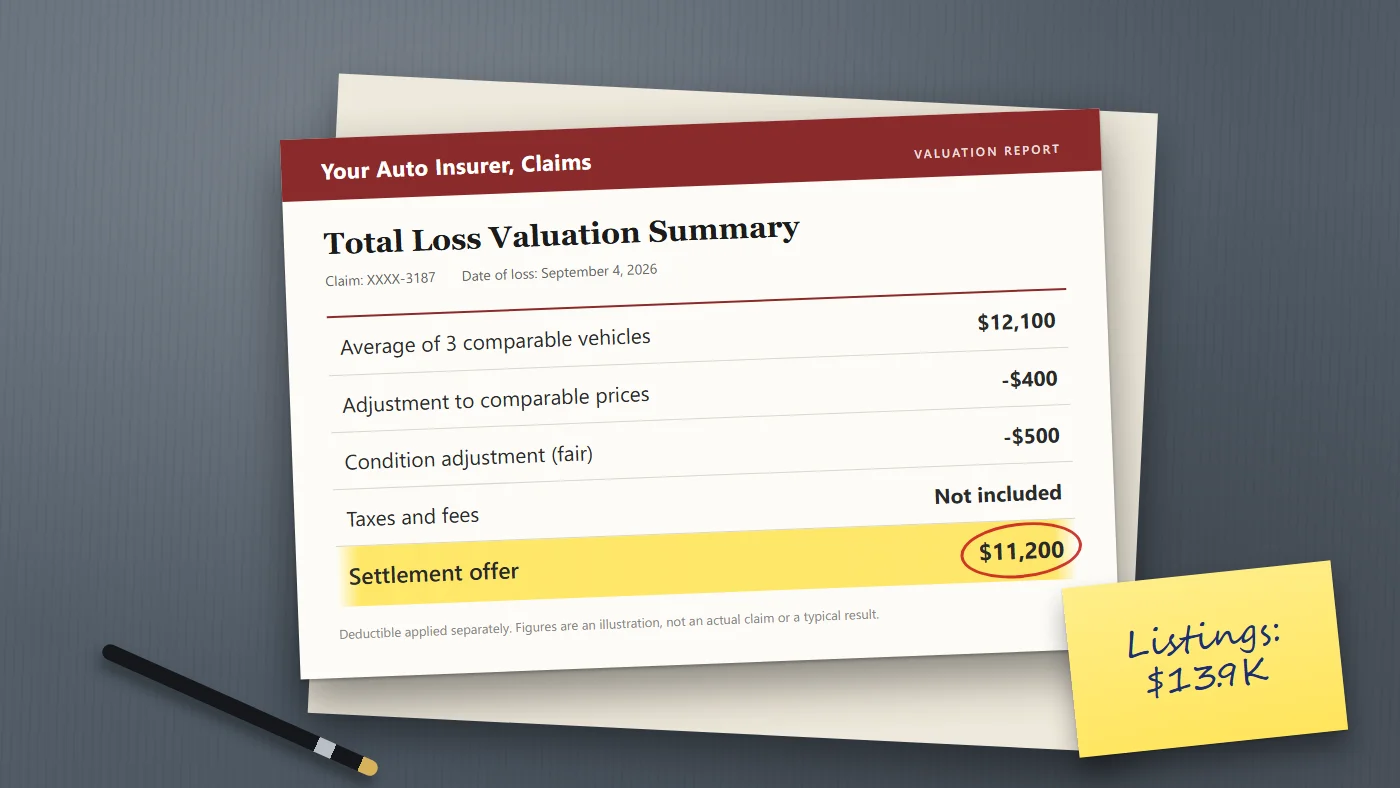
Any step in that chain can go wrong. The report can list the wrong trim, miss options, rate a well-kept car as "fair," pull comparables from 140 miles away or from listings that sold months ago, or leave out sales tax and title fees your state requires. None of that takes bad intent. It only takes nobody checking, and the one person with a reason to check is you. In the example below, an $11,200 offer sits $2,700 under local listings, and five lines of the report explain nearly all of it.
23.1%. The share of U.S. auto claims that ended as total losses in 2025, a record, according to CCC Intelligent Solutions. Nearly one claim in four now ends with a valuation report instead of a repair.
What a gap looks like on paper
Say the insurer offers $11,200 for a seven-year-old SUV. You search dealer sites within 50 miles and turn up four of the same year, model and trim with similar miles, and their asking prices average $13,900. That's a $2,700 difference. It needs explaining. (These numbers are made up to show the mechanics; your gap could be smaller or larger.)
| Line in the valuation report | What to check | Effect in this example |
|---|
| Trim and options | Report lists the base trim; yours is the mid-level trim with a towing package | +$900 |
| Condition score | Rated "fair" with no inspection notes; you have service records and recent photos | +$500 |
| Adjustment to comparables | Each listing price cut by a percentage for "expected negotiation" | +$400 |
| Comparables used | Two of three are 120+ miles away in a cheaper market | +$300 |
| Taxes and fees | Sales tax and title fee not included | +$700 |
Add up the documented corrections and you get about $2,800. Notice that not all of the asking-price gap was real, though. Asking prices aren't sale prices, and a used car often sells below its listing. What you can recover is the part you can prove.
Look at the table again. No single line is dramatic: the biggest is $900, and most are a few hundred. Together they cover nearly the whole gap, and each one ties to a piece of paper, whether that's a window sticker, a dated photo, a saved listing or a state rule. "My car was worth more" gives an adjuster nothing to work with. A VIN printout showing the towing package does.
That's the heart of a dispute. You aren't arguing that the offer feels low. You're correcting specific lines, with evidence.
Can software really shave money off every comparable?
It can, and it's been fought over in court. Some valuation reports knock a set percentage off every comparable listing on the theory that buyers negotiate below the sticker. Court filings call it a "projected sold adjustment."
Drivers have sued over it in several states, arguing the deduction is arbitrary and not based on actual sales. One large national insurer agreed to a $48 million settlement covering New York total loss claims, about 93,000 policyholders, and a $43 million settlement in Georgia. The Georgia class was roughly 151,000 people, with an estimated average payment of about $173 each. Other cases have gone the insurers' way or are still pending, and no court has declared the practice illegal nationwide.
Two things follow from that. The deductions often come to a few hundred dollars per car, not thousands. And they're visible, as line items in the valuation report, which means you can only question them once the report is in your hands.
So the first move is simple, and it's easy to skip when you're rattled and need a car by Monday.
How to dispute the offer, step by step
- Don't sign or deposit anything yet. Tell the adjuster you want to review the valuation before you respond. Ask whether cashing a check would count as accepting the settlement, and whether the company will pay the undisputed amount now while you work out the rest. Some will.
- Ask for the full valuation report in writing. Not the summary page. You want the version listing each comparable vehicle, each adjustment and the condition rating. Several states require insurers to explain this. California's claims regulations say the cost of a comparable car must be "fully itemized and explained in writing" when the offer is made, and Washington's require each addition or deduction to be itemized in dollars.
- Check the facts about your car. Compare the VIN, trim, engine, drivetrain, options and mileage on the report with your window sticker, purchase papers or a VIN decoder. Mistakes here are the most common and the easiest to fix.
- Check the comparables. They should be the same make and model, the same or a newer model year, similar trim and similar miles. Look at where they are: Washington, for one, caps the search at 150 miles from where the car is garaged. Look at the dates, too. A listing that vanished four months ago says little about today's market.
- Build your own comparables. Find three to five current listings near you that closely match your car. Save each as a PDF or screenshot showing the date, price, mileage, VIN and dealer. The Texas Department of Insurance also suggests getting quotes from used car dealers for what a car like yours would sell for.
- Document the condition. Pull together service records, recent photos, and receipts for tires, brakes or major mechanical work. The Texas Office of Public Insurance Counsel is blunt that an insurer probably won't pay more for custom parts, upgrades or recent maintenance, but it says to send the receipts anyway, because some things, such as a rebuilt motor, can add value.
- Ask about taxes and fees. Whether the insurer has to add sales tax, title and registration fees depends on the state. California and Washington require it. Ask the adjuster to show you where those amounts appear in the offer, and check your state insurance department's site for the rule where you live.
- Send one written counteroffer. Put your corrected figure, your comparables and your documents in a single email or letter. Ask for a written response and for a claims supervisor to review it. Keep it factual.
If they won't move
The appraisal clause. Most auto policies have one. If you and your insurer disagree on value, either side can demand appraisal. You hire an appraiser, the company hires one, and the two try to agree; if they can't, an umpire decides. According to the Texas Department of Insurance, you pay your own appraiser and half the umpire's costs.
That cost is where appraisal can backfire. Get the appraiser's fee in writing before you start and set it against the gap you're fighting over. It makes sense when the documented difference is well above the fees, and I'd rarely bother over $300. Wording and deadlines differ by policy and by state, so read the clause in your own policy first.
Appraisal applies to claims under your own policy. If the at-fault driver's insurer is paying, you have no contract with that company and no appraisal clause to invoke.
A complaint to your state insurance department. It's free and usually online. The department can't set your car's value, but it can make the company explain how it handled the claim, and regulators do watch complaint patterns. Attach your documents.
Court. Against the other driver's insurer, small claims court is often the practical route: you sue the at-fault driver, and their insurer defends. Limits vary by state. In Texas, for instance, the insurance department notes that Justice Court handles claims under $20,000 and you don't need an attorney.
A lawyer. For a pure property-value gap of a thousand dollars or two, legal fees can top what's at stake. A lawyer makes more sense if you were also hurt, if the insurer stops responding or won't share the valuation, or if the gap is large. Many attorneys who handle accident cases offer a free first consultation. None can promise an outcome.
Still paying off the car?
The insurer pays your lender first and you get whatever's left. If the loan balance is higher than the car's value, nothing's left, and you still owe the difference.
That's what GAP coverage is for. The Consumer Financial Protection Bureau describes it as an optional product meant to cover the difference between what you owe on the loan and what the insurer pays if the car's stolen or totaled. Check your purchase contract and loan papers to see whether you bought it. People forget, because it was folded into the financing.
A higher valuation helps here as well. Every dollar added to the actual cash value is a dollar less for you or the GAP provider to cover.
Keep making loan payments while the claim's open. A total loss doesn't pause the loan, and a missed payment lands on your credit report.
Keeping the car, and other details that cost money
You can usually keep a totaled car. The insurer subtracts the salvage value from your payment, and the car may get a salvage title. The Texas Department of Insurance warns that a vehicle that's had a salvage title "could be harder to sell or insure in the future." Rules for putting it back on the road differ by state.
Ask when your rental coverage ends. It may stop within days of the settlement offer, not when you finally agree on a number, and a long dispute can leave you paying for a rental out of pocket. Get the date in writing.
Before the car's towed to a salvage yard, take out your plates, toll tag, garage opener and personal things. Cancel coverage on that vehicle only after the settlement's done and the title has changed hands.
What counts as a total loss also varies. Texas generally uses 100% of the car's value, Florida 80% and New York 75%, and many other states use a formula comparing the repair cost plus salvage value with what the car's worth. If you'd rather have the car fixed than totaled, your state's threshold decides how much room there is to argue.
Replacing the car without losing more money
Two states build in a safety net. In California and Washington, if you can't find a comparable car for the settlement amount and tell the insurer within 35 days of payment, the company has to reopen the file. Other states have their own versions, and your state insurance department's site or consumer line can tell you what applies.
For the replacement, line up financing before you set foot in a dealership. A pre-approval from a bank or credit union gives you a rate to hold up against whatever the dealer offers, and since used car loan rates swing widely with credit score and vehicle age, it's worth getting two or three quotes in the same week.
Financing most of the price? Price GAP from your own auto insurer before accepting the dealer's version. The CFPB says it's important to compare prices and coverage, and your insurer or a direct lender may sell it for less.
And if the gap is big enough that you're weighing an independent appraiser or an attorney, get each one's fee structure in writing first, and set it next to the documented gap from your counteroffer.
This article is general information, not financial, legal, tax or medical advice.