Insurance
After a Car Accident: What to Say, What to Sign, and When the First Offer Is Too Low
A release signed in the first week covers every bill that shows up later, so the order in which you do things matters more than the amount of the first offer.
 Ray Castellano
Updated Sep 22, 2026 · 11 min read
A few days after a crash that wasn't your fault, the phone rings. The caller is polite, says they're with the other driver's insurance company, and wants to ask a few questions. They'd like to record the call. Sometimes, in that call or the next, they mention a dollar figure and say they can get a check out this week.
Nothing about that call is improper. It isn't a courtesy, either. It's business. The adjuster works for the company that'll pay your claim, and the two things that shrink what it pays are both on the table in that first conversation: your own words about fault and injuries, and your signature on a release.
It happens constantly. The National Highway Traffic Safety Administration estimates there were about 6.18 million police-reported crashes in the United States in 2024, and about 2.42 million people were injured in them. Most of those people had never handled a liability claim. The adjuster who called them does it every working day.
Four words cause more trouble than any others: "It was my fault." People say them at the roadside and again on the phone, often out of politeness, often before they know what happened. The Illinois State Bar Association's consumer guide is blunt about it: "Do not comment on the cause of the accident, and do not admit fault even if you think you were in the wrong." You may be shaken and in no state to judge. Fault gets decided later, from the police report, photos, witness accounts and the damage to each car.
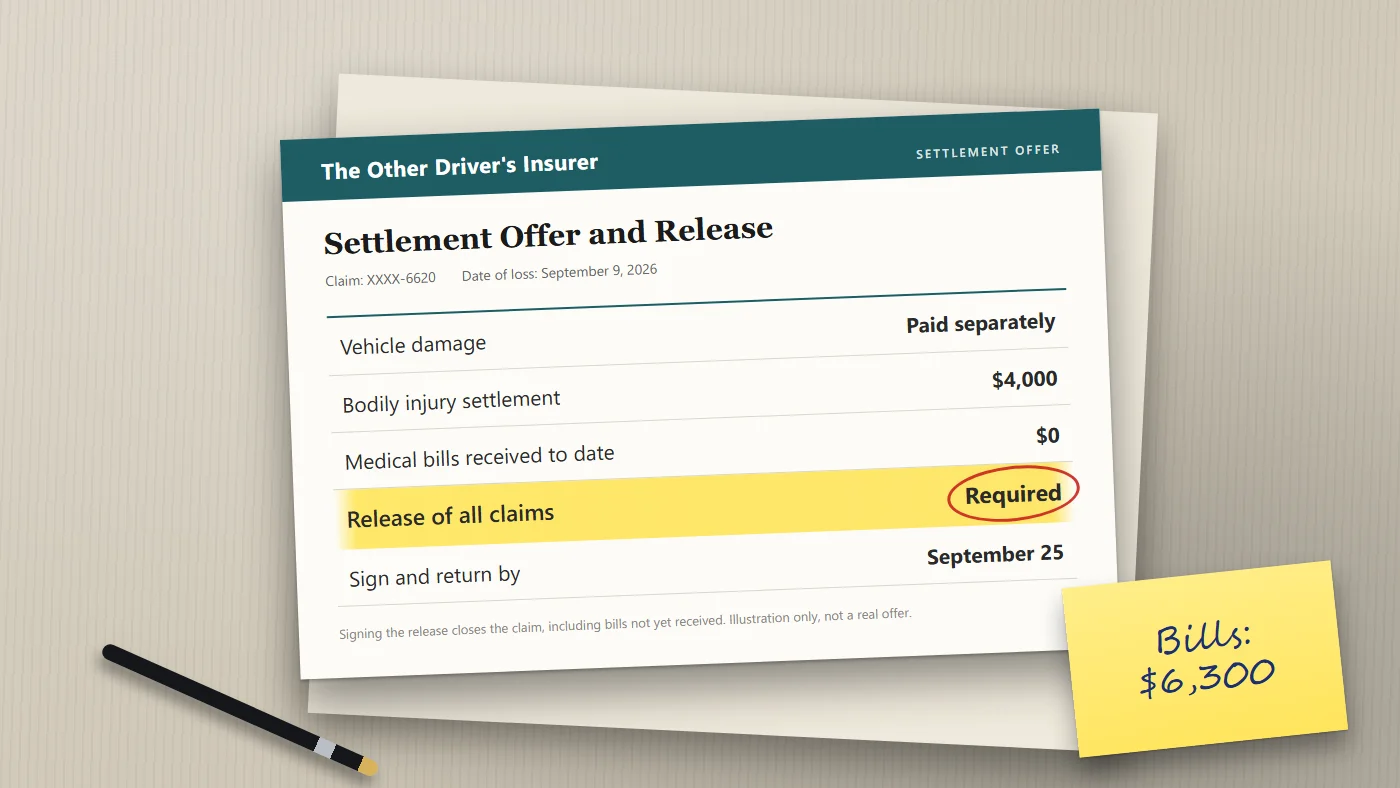
Here's how a quick settlement goes wrong, in a made-up example. An adjuster offers $4,000 a week after a rear-end collision, and the driver signs. Over the next month the bills trickle in: $3,100 from the emergency room, $1,400 for imaging, $1,800 for twelve physical therapy visits. That's $6,300, and the release signed for $4,000 covers every dollar of it.
2.42 million people were injured in U.S. traffic crashes in 2024, according to NHTSA. A release signed in the first week applies to bills that arrive in the third month.
What to say on that first call, and what to leave out
You can be courteous and brief at the same time. You have a contract with your own insurer, and it requires you to report the crash and cooperate. You don't have one with the other driver's company. In general you aren't required to give that company a recorded statement, and the Illinois bar's guide notes that you have the right to consult a lawyer before making any statement.
| Fine to say | Better left unsaid for now |
|---|
| Your name, address and phone number | "It was my fault" or "I didn't see him" |
| The date, time and location of the crash | "I'm fine" or "I'm not hurt" |
| The vehicles involved and your insurer's name | Guesses about speed, distance or timing |
| Where your car is, so it can be inspected | Details of your medical history |
| "I'm still being evaluated. I'll send records when treatment is done." | "Sure, you can record this" |
| "Please send that to me in writing." | "That amount sounds okay" |
Why single out "I'm fine"? On a recorded line it turns into a statement about your injuries, made before a doctor has seen you. A neutral answer is accurate and costs nothing: "I'm getting checked out."
If the adjuster keeps pushing for a recorded statement, say you'll provide information in writing. And if fault's in dispute or you were hurt, this is one of the moments when a short talk with an attorney, before any statement, can be worth the time.
Why does the offer come so fast?
A fast offer isn't always a bad one. After a minor crash with car damage only, a quick settlement can be fair and convenient, because property damage can be counted the same week. Repair estimate, rental bill, tow. Done.
Injuries are different, since in week one nobody knows the total. Emergency rooms, radiology groups, ambulance companies and physical therapists bill separately and on their own schedules, some bills take weeks to reach you, and follow-up care may not even be booked yet.
The Texas Department of Insurance tells people settling a claim that includes medical costs to talk with their doctor about any future treatment they might need before accepting. The reason is the release. The insurer will ask you to sign one, and a signed release blocks any future claim from that accident.
That's what the signature does. A release is a contract that ends the claim, and if the bills later run past the check, the difference is yours. You can't reopen it because the number turned out to be wrong.
And the papers that close a claim don't always say "release" at the top. Three kinds are worth knowing on sight.