You agree on a price for the car. Then someone walks you to a small office to "do the paperwork," and an hour later you drive home with a loan a few thousand dollars bigger than the price you negotiated. The difference is a stack of products you may barely remember signing for: an extended warranty, GAP coverage, maybe a protection package or credit insurance.
The Federal Trade Commission describes the moment well. "Often, add-ons can cost thousands of dollars and are mentioned only at the end of an already difficult and time-consuming day at the dealership." By then most buyers just want the keys. Plenty of them don't read the itemized list until a year or two later, when they refinance or trade the car in.
What the finance office doesn't stress is that these products are separate contracts, and they can usually be cancelled. The Consumer Financial Protection Bureau puts it plainly about optional add-ons sold with auto loans: "You have the right to cancel these add-on products at any time and reduce your costs." Cancel early and the refund may be the full price. Cancel later and it's usually prorated, meaning you get back the unused part, sometimes minus a fee.
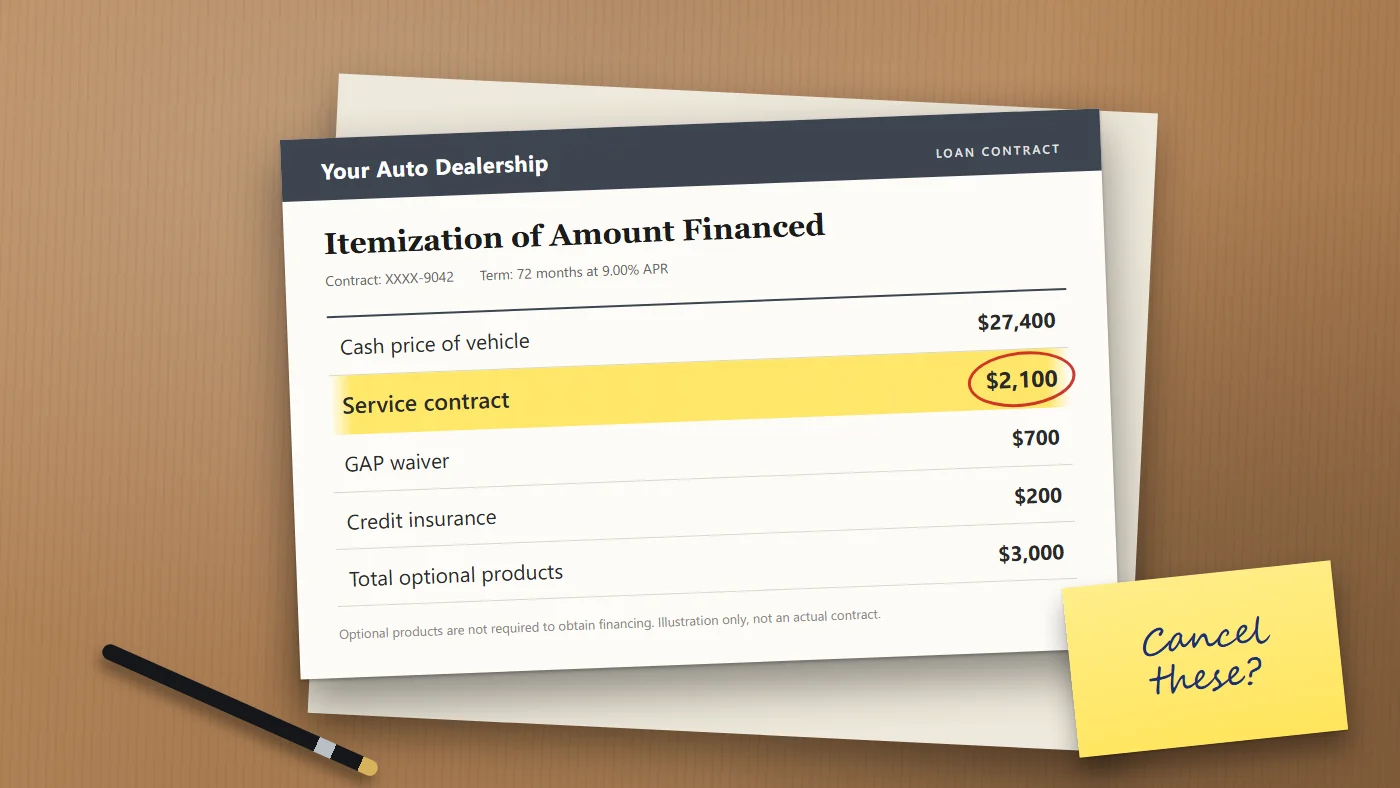
Doing nothing costs more than the sticker on the products, because you're paying interest on them. Say $3,000 of add-ons got rolled into a 72-month loan at 9% APR. That's about $54 added to every monthly payment. Over six years you pay $3,894 for them, and $894 of that is interest.
$894. The interest on $3,000 of add-ons financed for 72 months at 9% APR, in this example. The products cost $3,000. Financing them brings the total to $3,894.
Where do you find the add-ons?
In the retail installment contract. It's the long form with the federal truth-in-lending boxes across the top: APR, finance charge, amount financed. Below them sits a section called "Itemization of Amount Financed." Look for lines described as amounts paid to others on your behalf. That's where the add-ons live, each with a price and the name of the company that got paid.
Most of the money usually sits in three kinds of charges.
A service contract is often sold as an "extended warranty," but it isn't a warranty. It's a separate contract promising to pay for certain repairs, and you can say no to it.
GAP, or guaranteed asset protection, covers the difference between what you owe and what your insurer pays if the car's totaled or stolen. The CFPB calls it "an optional product." If a dealer told you it was required to get the loan, ask to see that in writing: under federal disclosure rules, if a lender requires GAP, its cost has to be included in the finance charge and the disclosed APR.
Credit insurance, meaning credit life and credit disability policies, makes loan payments if you die or become disabled. The FTC says credit insurance "is not required by federal law," and that it's illegal for a lender to slip it into your loan without your knowledge or permission.
Other lines may show up: tire-and-wheel protection, key replacement, prepaid maintenance, paint and fabric protection, window etching, theft-deterrent products. Whether those can be cancelled depends on what they are.
| Charge on the contract | Can it usually be cancelled? | What you typically get back |
|---|
| Service contract ("extended warranty") | Yes | Full refund in an early window in some states; after that, prorated by time or miles, less any fee and sometimes less claims paid |
| GAP waiver or GAP insurance | Yes | Prorated for the remaining loan term; often the full unused amount if the loan is paid off early |
| Credit life or disability insurance | Yes | The unearned premium |
| Tire-and-wheel, key replacement, prepaid maintenance | Usually | Prorated, according to the contract |
| Paint sealant, fabric protection, window etching already applied | Often not | These are products already delivered; read the contract, but expect little |
A general picture only. The real terms sit in each product's contract and your state's law.
Where the money goes
If you still owe on the loan, the refund almost always goes to the lender, not to you. The lender's usually listed as lienholder on the product contract, and the product was bought with the lender's money.
The lender applies the refund to principal. Your payment normally stays put. What changes is the balance: you owe less, pay less interest from then on and finish sooner, a real gain even if the monthly bill looks exactly the way it did before you made a single phone call. In the $3,000 example, about $2,600 of the add-on money is still owed after 12 payments. A refund of roughly $2,280, like the one worked out below, would wipe out most of it.
That's how it works while the loan's open. Once it's closed, the refund takes a different path, and that's the one people miss most.
If the loan's been paid off, refinanced with another lender or closed out in a trade-in, the refund should come to you by check. Paying off early usually doesn't cancel the service contract or GAP on its own, though. The CFPB notes that you may be entitled to a GAP refund if you sell, refinance or prepay the loan. Somebody has to ask.
Want a lower monthly payment, not just a shorter loan? Cancelling is half the job. Refinancing is the other half.
How to cancel, step by step
- Start with a list. Work from the itemization of amount financed and write down each add-on, its price and the company named.
- Each product has its own contract. Look for a section headed "Cancellation" or "Termination." It'll say who to contact, how the refund is calculated, whether there's a fee and whether the dealer has to sign the request. Can't find the contract? Ask the dealer's finance office for a copy. If that goes nowhere, ask your lender who the product administrator is.
- Take a photo of the odometer today. Why bother? Service contract refunds are usually based on time elapsed or miles driven, and many contracts use whichever leaves you less.
- Put the cancellation in writing. Many administrators have a form, and some require it to go through the selling dealer. Sign it, keep a copy and mail it with tracking, or if you drop it off at the dealership, get a signed and dated copy back.
- Ask for the refund calculation in writing: the method, the fee, the dollar amount. CFPB examiners have found auto loan servicers miscalculating refunds on add-on products, in some cases leaving borrowers with balances hundreds of dollars too high, so check the math against the contract.
- Where's the money going? If the loan's open, tell your lender a refund is on the way and ask that it be applied to principal. If it's closed, the administrator needs your current address and needs to know there's no lienholder.
- Refunds can take weeks, so put a follow-up date on the calendar. Nothing on your loan statement or in the mail by then? Call the administrator first and the dealer second, and ask for the payment date and amount.
- Stuck? Escalate. A dealer has little reason to hurry, since a cancelled product can mean handing back part of a commission. Start with a short written complaint to the dealership's general manager. Past that, there's the state attorney general's consumer protection office, the state agency that licenses dealers, or the state insurance department, which oversees service contracts in many states. Problems with how a lender handled the refund go to the CFPB.
What a prorated refund looks like
An illustration, and your contract may differ.
Say you bought two things with the car: a six-year, 75,000-mile service contract for $2,100 and a $700 GAP waiver, on a 72-month loan. Twelve months and 11,000 miles later, you cancel both.
How much of the service contract have you used? By time, one year of six, so five-sixths is left. By miles, a bit more than that is left. The contract goes with the smaller figure, so time wins.
Five-sixths of $2,100 is $1,750. Then comes the cancellation fee, $50 here, which leaves $1,700.
GAP is simpler. It runs with the loan, and 60 of the 72 months are still ahead. You get back that share of $700, about $583.
Add the two and roughly $2,280 comes off the loan balance.
Could it be less? Yes. Some service contracts subtract the value of claims they've paid, and cancellation fees vary.
A few states cap them. California's Civil Code requires a full refund if you cancel a service contract within 60 days on a new vehicle, as long as no claim's been made. On a used one without a manufacturer's warranty, the window is 30 days. After that the refund is prorated, and the fee can't be more than 10% of the contract price or $25, whichever is less. Other states have their own rules. Some have none.
Is there a federal rule on add-ons?
Not anymore. There's no federal right to return a car, either: "Federal law doesn't require dealers to give you three days to cancel the deal and return the car," the FTC says.
The FTC did write an add-on rule. Its Combating Auto Retail Scams (CARS) Rule was finalized in December 2023, and under it dealers would have needed your express, informed consent before charging for any add-on. Charges for add-ons that give you no benefit would have been barred. The FTC put it on hold while dealer groups challenged it, and on January 27, 2025, the federal Fifth Circuit Court of Appeals vacated it on procedural grounds, finding the agency had skipped a required advance notice step. The FTC formally withdrew it in February 2026.
That leaves state law, which varies. California's is the newest. Its own CARS Act, SB 766, was signed in October 2025 and becomes operative on October 1, 2026.
It does two things buyers will notice. Dealers can't charge for add-ons the buyer can't benefit from, such as oil changes sold with an electric car. And on used vehicles priced at $50,000 or less, buyers get three days to cancel, as long as the car's been driven no more than 400 miles. The restocking fee is 1.5% of the price, at least $200 and no more than $600, plus a mileage charge past 250 miles.
Charged for something you never agreed to, or told a product was required when it wasn't? That's not a routine cancellation. Report it to your state attorney general's office. A consumer attorney can tell you whether your state's law gives you more than a prorated refund.
Before you cancel everything
Not every add-on is a bad buy for every owner.
GAP matters if you owe more than the car's worth, which is common in the first years of a long loan with a small down payment. In that spot, don't go without it. Your auto insurer or a direct lender may sell the same protection, and the CFPB says it's important to compare prices and coverage. Buy the replacement first and cancel the dealer's version second, so there's no gap in the GAP.
When is a service contract worth keeping? When the manufacturer backs it, the car has a poor repair record, and a $3,000 repair bill would put you in debt. It's less useful if it overlaps a factory warranty with years left on it, or if you can't find out anything about the company behind it. The FTC suggests comparing it with the manufacturer's warranty, checking whether you'll owe a deductible on each repair and finding out who's actually responsible for paying claims.
Credit insurance is rarely the cheapest way to protect a loan. Already carry term life or disability coverage? Check whether it would handle the balance. If it would, the credit policy may be paying for the same thing twice.
After the refund: fixing the payment itself
Cancelling add-ons shrinks the balance. It doesn't touch the interest rate, and it usually doesn't change the monthly payment either.
If your rate was set at the dealership, see what a bank or credit union would offer on the smaller balance. A lower amount at a lower rate is how the payment comes down. A car loan calculator shows the effect before you apply: enter the new balance, the months left and the quoted rate, then compare the payment and total interest with what you have now.
Order matters. Request the cancellations, wait for the refunds to post, then get refinance quotes on the reduced balance. Do it the other way around and the old loan closes first, so the refunds come to you by check and you'd have to send that money to the new lender yourself. If I had add-ons on an open loan, that's the sequence I'd follow.
Planning to trade the car in or pay off the loan soon? Put "cancel add-ons" on the same to-do list as the payoff letter.
This article is general information, not financial, legal, tax or medical advice.