The average new-car payment hit $777 a month in the second quarter of 2026, according to Edmunds. For a lot of households that's one of the biggest bills after housing. And unlike the mortgage, it was probably signed in a small office at the back of a dealership, at the end of a long afternoon.
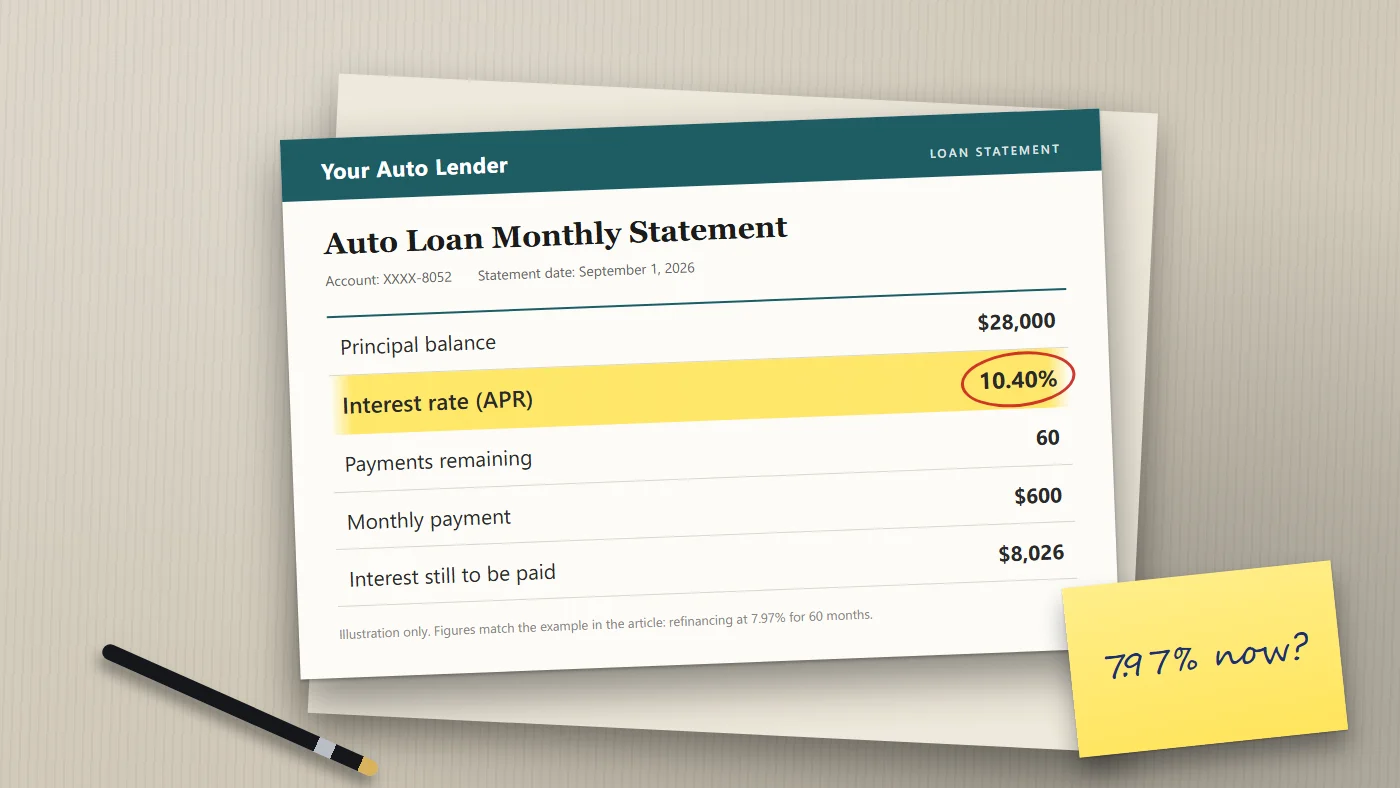
You aren't stuck with it. A car loan can be replaced by a new one from a different lender, at a different rate, without trading in the car. Experian, which tracks auto lending nationwide, reported that owners who refinanced in the second quarter of 2026 went from an average rate of 10.40% to an average of 7.97%. Their payments dropped by $83 a month on average.
Averages hide two very different stories, though. Some of those owners cut their rate and paid less for the car in the end. Others got the smaller payment mostly by adding months, and they'll pay more overall. From the outside the two look identical: a smaller monthly bill. Telling them apart is what the rest of this article is for.
Start with where your original rate came from. It explains why there's often room to improve it.
Why a dealership loan often has room in it
Many car loans are arranged by the dealer rather than by a bank the buyer picked. The Consumer Financial Protection Bureau lays out how that works. The dealer sends your application to one or more lenders, and a lender answers with a "buy rate," the rate it's willing to give you. The rate on your contract can be higher, to compensate the dealer for arranging the loan.
Nobody's obliged to hand you the best deal, either. In the CFPB's words, dealers and lenders aren't required to offer the best rates available. Many lenders cap how much a dealer can add, but you won't see the buy rate on your contract. Only the final number.
What few buyers hear is that the rate is negotiable, just like the price of the car. The CFPB says so directly. Almost nobody tries. After two hours of paperwork, most people sign what's put in front of them.
So if your loan came through a dealership and you never compared it with an outside offer, a bank or credit union might have beaten it that same day. Refinancing is how you go back and check.
In the second quarter of 2026, owners who refinanced through a credit union lowered their payment by an average of $102 a month. Through banks the average was $65, and through finance companies $38, according to Experian.
What's changed since you signed?
Three things can make a new loan cheaper than the old one.
Rates came down a little. Experian puts the average new-car loan rate at 6.35% in the second quarter of 2026, down from 6.79% a year earlier. Used-car loans averaged 11.19%, down from 11.57%. If you borrowed in 2023 or 2024, you probably did it near the peak.
Your credit may have moved. A year or two of on-time payments, a paid-off card or an old late payment aging off your report can push you into a better pricing tier, and the tiers are far apart. LendingTree's marketplace data for the second quarter of 2026 shows refinance rates averaging 5.84% for scores of 800 and up, 7.14% for scores from 670 to 739, and 12.50% for scores under 580.
You've got time to shop. At the dealership you had one offer and a salesperson waiting. At home, you can collect five.
None of that helps if the new loan is built the wrong way. Refinance ads rarely mention this part.
The payment can fall while the cost rises
Say you owe $28,000 with 60 months to go at 10.40%. Your payment's about $600. A lender offers you the Experian average of 7.97%, and there are two ways to take it.
| Keep current loan | Refinance, same 60 months | Refinance, stretch to 72 months |
|---|
| Rate | 10.40% | 7.97% | 7.97% |
| Monthly payment | $600 | $567 | $491 |
| Interest still to pay | $8,026 | $6,040 | $7,317 |
| Change in total cost | | saves $1,986 | saves $709 |
The same-term refinance cuts the payment by only $33, yet it saves nearly $2,000. The 72-month version feels far better every month, $109 lower, and hands back almost two-thirds of that saving in extra interest. Stretch it further, or refinance at a rate barely below your current one, and you can end up paying more than if you'd done nothing at all.
The CFPB puts it in one line: a longer term may mean lower monthly payments but more interest over the life of the loan.
Is a longer term always a mistake? No. If the alternative is missed payments, a smaller bill can be worth paying extra for. The Federal Reserve Bank of New York reported that auto loans moved into serious delinquency at an annualized rate of 3.00% in the second quarter of 2026, up from 2.93% a year earlier, with household auto debt at $1.71 trillion. Plenty of people are under real pressure right now, and if that's you, pick the longer term on purpose, knowing what it costs, rather than finding out later.
When refinancing usually pays
You're a good candidate if most of these fit.
- Your rate is at least one to two percentage points above what lenders quote for your credit tier today.
- A dealer arranged the loan and you never compared outside offers.
- Your credit score is clearly higher than when you bought.
- You've got at least two years left. Interest is front-loaded, so the earlier you refinance, the more there is to save.
- The car's worth more than you owe, or close to it.
When it usually doesn't
Near the end of the loan, it rarely works. The math's against you. With 12 or 18 months left, most of the interest is already paid, and a new loan's fees can eat whatever's left to save.
Owing more than the car is worth is another problem. Lenders look at loan-to-value, and if you're well underwater, most will say no; the ones that say yes will charge for the risk. Old cars and small balances run into lender rules too. They differ, but Bankrate's rundown is typical: many lenders want a car under 10 years old with fewer than 100,000 to 150,000 miles, a balance of at least $3,000 to $7,500, and six months of payments on the current loan.
Then read the fine print on the old loan. Refinancing pays it off early, and the CFPB notes that whether a lender can charge you for that depends on your contract and your state's law. Some states prohibit prepayment penalties on certain loans. The Truth in Lending disclosure that came with your contract will tell you.
And if your score has dropped since you bought? The offers may be worse, not better. Checking costs nothing. Just don't count on a lower rate.
How to refinance, step by step
- Pull the facts on your current loan. You need the APR, the monthly payment, the number of payments left and the 10-day payoff amount. The payoff is what it costs to close the loan today, and it's a little higher than the balance on your statement. Ask the lender if there's a prepayment penalty.
- Look up the car's value. Use two or three pricing guides with your real mileage and compare the trade-in value with your payoff. If you owe more than it's worth, read our guide to negative equity before going further.
- Check your credit reports. They're free at AnnualCreditReport.com. Dispute errors before you apply, not after.
- Get at least three quotes. Include a credit union, a bank and an online lender. Many will prequalify you with a soft credit check that doesn't affect your score. When you move to full applications, bunch them together: the CFPB says auto loan inquiries made within a 14- to 45-day window generally count as a single inquiry.
- Compare offers at the same term. Ask each lender to quote the months you have left. Look at a longer term only if you need the lower payment, and write the extra interest down right next to it.
- Add up the fees. Some lenders charge an origination or processing fee, and your state will usually charge to put the new lienholder on the title. Subtract all of it from the saving.
- Keep paying the old loan until it's closed. The new lender sends the payoff directly. Until you have written confirmation of a zero balance on the old account, make every scheduled payment, because a payment missed during the handoff lands on your credit report like any other.
- Deal with the add-ons. GAP coverage or a service contract bought through the dealer may be tied to the original loan. GAP often ends when that loan's paid off, and you may be owed a prorated refund, so ask the provider in writing. Still owe close to the car's value? Price new GAP coverage through your auto insurer or credit union.
Most of this happens online and by mail. The car never leaves your driveway.
One tax detail for cars bought new since 2025
If you bought a new, U.S.-assembled vehicle with a loan taken out after December 31, 2024, the interest may be deductible under the car loan interest deduction for tax years 2025 through 2028. Refinancing doesn't end that. The IRS says interest on a refinanced loan is generally still eligible, and the final Treasury regulations published September 8, 2026, cap the qualifying part at the balance of the original loan on the day you refinance. Cash out or roll other debt in, and the interest on that extra portion doesn't count.
Comparing offers without a salesperson in the room
Few money chores reward comparison like this one does, because the product's the same from lender to lender. A loan is a rate, a term and a fee. Whoever gives you the lowest total cost for the term you want wins. Simple as that.
That's why Experian's numbers by lender type are useful. Credit unions produced the largest average saving, $102 a month, and most let you join with a small deposit based on where you live or work. Banks and online lenders run promotions that change month to month, so they belong on the list too. Looking up current auto refinance rates for your credit tier takes a few minutes, and it tells you right away if your present rate is out of line.
Keep a loan calculator open as well. Plug in your payoff, the quoted rate and the months you've got left, then change only the term and watch the total interest. The calculator will show you that number. An ad usually won't.
If the payment's already more than you can handle, call your current lender before you fall behind. The CFPB suggests asking about a due-date change, a payment deferral or a modified plan. I'd make that call this week rather than next month, since lenders tend to have more room to help a borrower who's current than one who's 60 days late.
Before any of that, find your last statement and circle two numbers: the APR and the payments remaining. Those two decide most of this.
This article is general information, not financial, legal, tax or medical advice.