Home & Mortgage
Walk-In Tubs, Stairlifts and Ramps: What Aging in Place Costs and Who Helps Pay
Medicare pays for almost none of it, so here are the real price ranges and the short list of programs that do help.
 Ray Castellano
Updated Sep 22, 2026 · 11 min read
The national median for an assisted living community hit $6,200 a month in CareScout's latest Cost of Care Survey, released in March 2026 with data collected in 2025. That's $74,400 a year, 5% more than the year before. Medicare won't pay it.
Most people don't want to move anyway. In AARP's 2024 Home and Community Preferences Survey, 75% of adults 50 and older said they'd like to stay in their current home as they age, and nearly half expected the house would need changes to make that work. Grab bars and easier entryways topped their list.
Behind a lot of those answers sits one fear, a fall. About one in four adults 65 and older reports falling each year, according to the CDC. Families usually look at the bathroom first. Then the stairs.
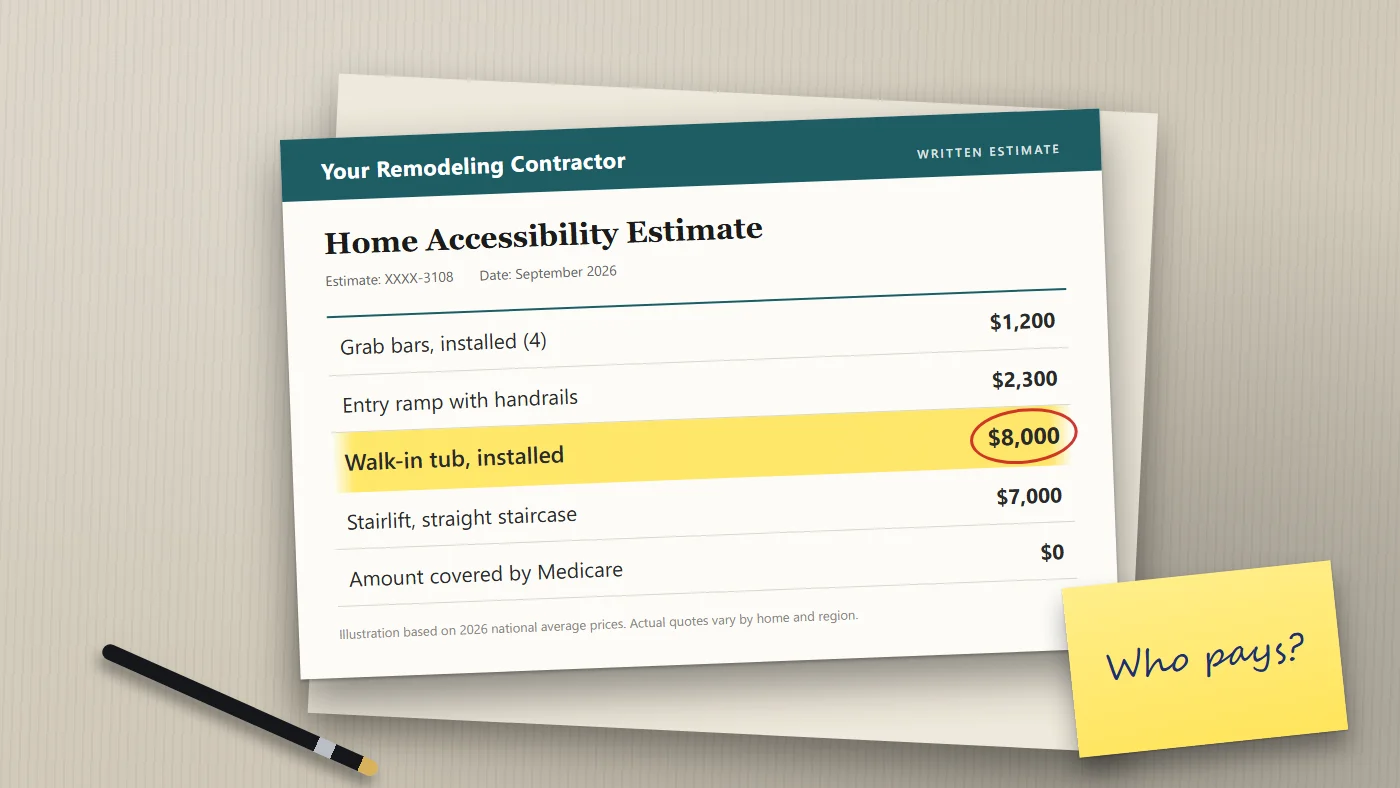
The fixes aren't free. A walk-in tub averages about $8,000 installed, a stairlift on a straight staircase runs about $7,000, and a curved one can cost nearly twice that. Medicare doesn't cover those either, which surprises plenty of people who assumed anything "medical" in the home would count.
So you're weighing a one-time bill against a monthly one that doesn't stop. Almost all of the one-time bill starts out as yours, though. Below are the real price ranges, followed by the handful of programs that can pick up part of it.
$6,200: one month of assisted living at the national median. A wheelchair ramp, four grab bars and a tub-to-shower conversion together average about $6,500, and you pay for them once.
What the common changes cost in 2026
These numbers come from Angi's 2026 cost guides, which are built from projects that homeowners and contractors report. Your own quote will depend on the house, the region and how much plumbing or framing is hiding behind the wall.
| Modification | Typical cost, installed | What moves the price |
|---|
| Grab bar | $200–$350 per bar | Wall reinforcement, tile, number of bars per visit |
| Wheelchair ramp | About $2,300 average; most pay $1,100–$3,600 | Length, material, handrails, permits |
| Tub-to-shower conversion | About $3,000 average; $1,500–$15,000 | Prefab stall or custom tile, hidden water damage |
| Walk-in tub | About $8,000 average; most pay $4,000–$15,000 | Jets, heated seat, door style, electrical and drain work |
| Stairlift, straight stairs | About $7,000 average | Rail length, seat type, new or reconditioned |
| Stairlift, curved stairs | About $13,000 average; $9,000–$30,000 | Custom-built rail, landings, turns |
Start at the top of the table. The cheapest items are also the ones AARP's respondents said they'd need most, and a set of four grab bars, put in by a handyman who knows to anchor them into studs or blocking instead of bare drywall, costs less than a single week of assisted living.
The bottom half is a different story. Walk-in tubs and curved stairlifts carry ranges so wide that two dealers can quote $4,000 and $15,000 for what looks like the same tub in the brochure. A curved rail is built for exactly one staircase, so it has almost no resale value, and quotes for it are all over the map.
Say you need the whole package: four grab bars at $300 apiece, a $3,000 tub-to-shower conversion, a $2,300 ramp and a $7,000 straight stairlift. That's about $13,500. Real money. It's also a little over two months of assisted living at the median.
Is staying home always the cheaper choice?
No. You should see why before you sign a remodeling contract.
A safer bathroom removes a fall hazard, but it doesn't replace a person. If you or a parent later need hands-on help with bathing, dressing or meals, that help costs money at home too, and the hours add up faster than most families expect. CareScout puts the national median for a non-medical in-home caregiver at $35 an hour. At 44 hours a week, the schedule CareScout uses for its annual figure, that's $80,080 a year. It's more than the assisted living median.
So the honest version goes like this. Modifications pay off best for people who are still independent and want to stay that way longer. They're a weaker bet once someone needs many hours of daily care. Most families land somewhere in between, and you're the one who knows where.
Timing matters too. The same AARP survey found that 44% of adults 50 and older expect to move at some point, with rising rent or mortgage costs the most common reason. If a move looks likely in the next couple of years, I'd spend on the cheap fixes and think hard before ordering a custom rail that can't come with you. A ramp and a walk-in tub stay behind when you sell. Whether the next buyer sees them as a plus is anyone's guess.
The price table also leaves out who pays. Families tend to assume Medicare covers "medical" equipment in the home, and a stairlift certainly feels medical. Medicare sees it another way, and the whole difference comes down to one definition.