Call three dental offices about one implant and you can hear three prices that sit thousands of dollars apart. That's normal. It doesn't mean anyone's lying to you. AARP's pricing guide, published in April 2024, puts a single implant at $3,000 to $4,500 from start to finish, and GoodRx's cost guide runs wider, at $3,000 to $7,000 per tooth.
Original Medicare pays none of it. Medicare.gov says it doesn't cover "items like dentures and implants," and that you pay all costs for dental services it doesn't cover. Private dental insurance helps some, but those plans have a yearly maximum, and it's often somewhere around $1,000 to $2,000.
So most of the bill is yours. You'll rarely find the price posted anywhere, either, because offices quote each mouth on its own after an exam and a scan. The number you hear at the consult shows up with no easy way to tell if it's high, low or missing pieces.
This guide covers what that number ought to include, what tends to get added later, how the alternatives compare on price and the routes people actually use to pay less. It won't tell you which option is right for your mouth. That's between you and a dentist. This one's about the money.
What's inside the price of one implant?
A single implant is really three parts, and offices often bill them as three lines.
There's the post, a small screw set into the jawbone by a surgeon or a dentist trained to place it. On top of it sits the abutment, a connector. Then comes the crown, the tooth you actually see. Clinic-published price guides for 2026 put the post at roughly $1,000 to $2,000, the abutment at $300 to $500 and the crown at $1,000 to $3,000.
Sometimes two offices split the job. An oral surgeon or periodontist places the post, and your regular dentist makes the crown months later, which means two quotes, two bills and an ad reading "implants from $1,500" that may describe only the first of them.
That's why quotes look so far apart. One office is pricing the whole tooth. The other's pricing a part.
Even an all-in quote usually covers just the implant. Work around it gets priced separately, and it's a clinical call, made after the exam and imaging, whether any of it is needed.
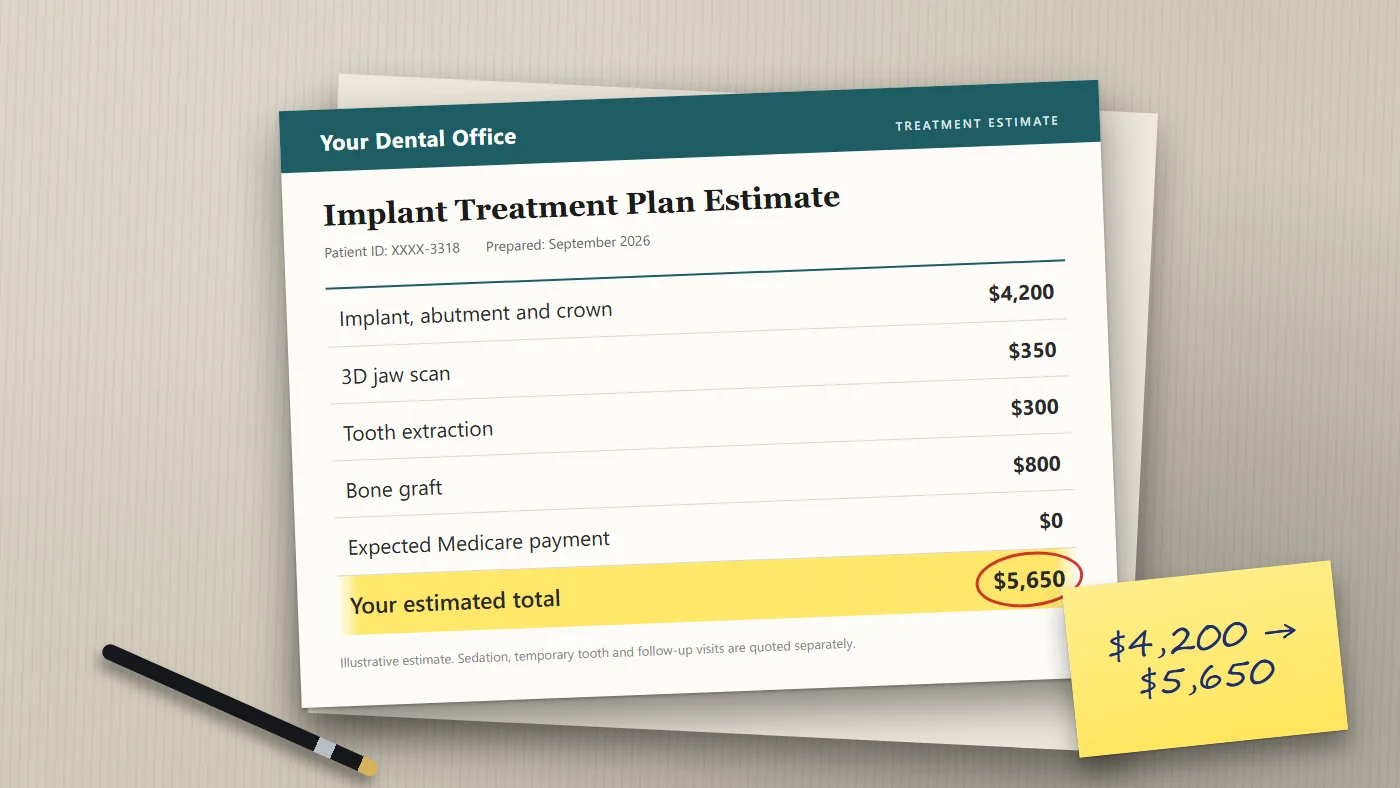
Clinic-published ranges for 2026 run like this: a 3D scan of the jaw, $100 to $500; pulling the old tooth, $150 to $800; a bone graft, if the dentist says the jaw needs one, $300 to $3,000 depending on size. Sedation and a temporary tooth may or may not be in the quote. Add up the low and high ends and the extra work comes to roughly $550 to $4,300.
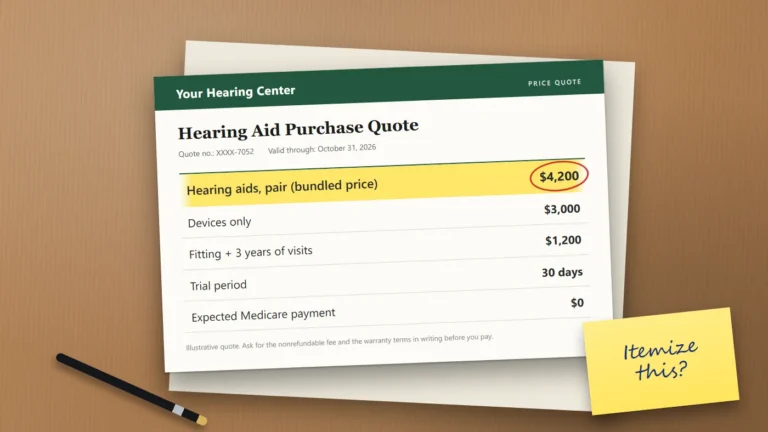
Say you're quoted $4,200 for one implant. Sounds like the middle of the range. Now add a $350 scan, a $300 extraction and an $800 graft, and the real total is $5,650. Nothing in that made-up example is hidden. It just wasn't in the first number.
The number to remember: Original Medicare pays $0 toward a dental implant. In KFF's review of 2021 Medicare Advantage plans with more extensive dental benefits, the average yearly cap was about $1,300, and the most common coinsurance for major work was 50%.
What insurance and Medicare actually pay
Original Medicare covers dental care only in narrow medical situations. Medicare.gov's examples include an oral exam before a heart valve replacement or an organ transplant, and a procedure like an extraction to treat a mouth infection before cancer treatment. Replacing a missing tooth isn't on the list.
Medicare Advantage looks better on paper. KFF reports that 98% of people in individual Medicare Advantage plans in 2026 have some dental benefit, but it also says that benefit may cover only preventive care like cleanings and X-rays. In its detailed look at 2021 plans, the ones with more extensive dental coverage capped it at about $1,300 a year on average, and 59% of enrollees in those plans had a cap of $1,000 or less. Against a $5,000 bill, that's a discount. It isn't coverage.
What about a regular dental plan? Stand-alone plans tend to work the same way. They carry a yearly maximum, often pay 50% for major work like implants, and many make you wait months before major work is covered at all. Some exclude implants outright, or won't pay to replace a tooth that was already missing when you enrolled.
The gap is wide. KFF found that about 24 million people on Medicare, 47%, had no dental coverage of any kind in 2019. The question isn't a rare one, either: CDC data from 2017 to March 2020 show about 1 in 10 adults ages 65 to 74, and 1 in 5 adults 75 and older, had lost all their teeth.
Treat the first quote as a starting point. What the alternatives cost, and what you do in the two weeks after the consult, decide most of what you'll end up paying.
How the other options compare on price
Implants are one of several ways to replace teeth, and the price spread between them is big. The table compares published ranges and nothing else. Which options are open to you is a clinical question.
| Option | Published price range | Source and date |
|---|
| Removable partial denture (acrylic) | $695 to $1,200 | AARP, April 2024 |
| Full set of conventional dentures | About $1,800; range $800 to $3,100 | GoodRx cost guide |
| Fixed bridge | $1,000 to $5,000 per tooth | AARP, April 2024 |
| Single implant with crown | $3,000 to $4,500 (AARP); $3,000 to $7,000 (GoodRx) | AARP, April 2024; GoodRx |
| Snap-in denture held by implants | $5,000 to $12,000 per arch | Clinic-published, 2026 |
| Fixed full-arch implants | $14,000 to $36,000 per arch | Clinic-published, 2026 |
An arch is one jaw, upper or lower. A full mouth is two arches, so the last two rows double. Cheaper options carry repeat costs too, since dentures get relined and replaced over the years. I'd ask any office quoting you to put both the upfront price and the expected upkeep in writing.
Comparing implant quotes, step by step
You can't compare two quotes until they describe the same work. These steps get you there.
- Ask for a written treatment plan with procedure codes. Dental offices bill with CDT codes. Surgical placement of the implant post is D6010. A custom abutment is D6057, and an implant crown is commonly D6058. A bone graft placed when a tooth is pulled is often D7953. With codes in hand, a second office can price the identical list.
- Ask what's not included. Go down the list out loud: exam, 3D scan, extraction, bone graft, sedation, temporary tooth, abutment, final crown, follow-up visits. Write "included" or a dollar figure next to each one.
- Ask who does each part. If a specialist places the post and another office makes the crown, get both fees before you agree to the first.
- Get a predetermination from your plan. If you've got dental coverage, the office can send the treatment plan to the insurer before any work starts. The reply shows what the plan expects to pay, what counts against your yearly cap and whether a waiting period or missing-tooth clause applies.
- Get a second quote on the same codes. A second consult may carry its own exam or imaging fee. Ask if the first office will release your scan so you don't pay for it twice.
- Ask about timing across benefit years. Implant work often stretches over several months. If the surgery lands in one plan year and the crown in the next, two yearly caps may apply instead of one. Your insurer can confirm how your plan counts it.
- Ask for the pay-in-full price. Some offices knock a few percent off for paying up front by check or debit card. Get any discount written on the treatment plan.
Keep every version of the plan. If the final bill doesn't match, the signed plan is what you point to.
Seven ways people pay less
None of these is a trick. Each one costs you something else, like time, travel or your choice of dentist.
Dental school clinics. Students do the work under licensed faculty, and the National Institute of Dental and Craniofacial Research describes that care as closely supervised. AARP says most procedures at dental schools run 30% to 50% below private practice. Expect longer appointments and a waiting list.
Community health centers. Federally funded health centers charge on a sliding scale tied to income. Services vary a lot. Call and ask if the center does extractions, dentures or implant work before you book anything.
A Medicare Advantage or stand-alone dental plan. Read the evidence of coverage for the yearly cap, the coinsurance on major services and any waiting period. A plan with a $2,000 cap that pays 50% can take $2,000 off a big case, but only once the wait is over.
Dental savings plans. They're memberships, not insurance. You pay a yearly fee and get a reduced fee schedule at participating dentists. Usually there's no cap and no waiting period, and also no payment from the plan. Ask the dentist for the member price on your exact codes before you join.
HSA and FSA money. Dental treatment is a qualified medical expense, so pre-tax dollars can cover it. If you're still working and have one of these accounts, the tax break works like a discount.
The medical expense deduction. IRS Publication 502 lists artificial teeth and dental treatment as medical expenses. If you itemize, you can deduct the part of your total medical and dental costs above 7.5% of your adjusted gross income. A big implant case in one calendar year can push you over that line.
Medicaid, in some states. States decide whether to give adults dental benefits, and the ones that do differ widely in what they cover. Check your own state's program before you assume either way.
Read the financing offer before you sign
Plenty of dental offices slide a medical credit card application or a payment plan across the front desk. The Consumer Financial Protection Bureau looked at these products in a May 2023 report. It's a short read.
The typical deferred-interest rate on the medical credit cards it reviewed was 26.99%. Deferred interest works like this: a "no interest for 12 months" offer is free only if you pay off the whole balance in time. Miss by a dollar and the interest comes back, charged all the way to the purchase date. The CFPB found patients paid $1 billion in deferred interest on these cards and loans from 2018 through 2020.
So ask before you sign. What's the APR once the promo ends? Is the interest deferred or actually waived? What monthly payment clears the balance a month early? If the office has an in-house plan with no interest at all, look at that first, and a personal loan or a card with a lower rate may cost less, too.
Mistakes that raise the bill
- Comparing an all-in quote with a post-only quote.
- Starting treatment before the insurer's predetermination comes back.
- Buying a dental plan for an implant without reading the waiting period and the missing-tooth clause.
- Paying the minimum on a deferred-interest card and assuming the promo protects you.
- Paying for a second 3D scan when the first office would've released the file.
- Accepting a verbal discount that never makes it onto the written plan.
Where does a price search fit in?
Once you have a written plan with codes, shopping gets simple, and it pays off. Implant fees are set office by office. For the same list of codes, the spread inside one metro area can run into the thousands.
At this stage people usually look up a few things. They check what dental implants cost in their own area. If several teeth are involved, they compare full mouth dental implants with snap-in dentures. People on Medicare look for dental implants for seniors and for plans that spell out implant coverage in writing. And some price affordable dentures as a baseline, so they know what the cheaper route would run.
If you only do one thing after the consult, get two written quotes built on the same codes and lay them side by side.
Then look past the headline number on each. One implant runs $3,000 to $4,500 in AARP's 2024 guide and up to $7,000 in GoodRx's, and the scan, extraction and graft can add roughly $550 to $4,300 on top. Original Medicare pays nothing. Dental benefits run out fast.
With codes on paper, a dental school, a second office and your insurer can all price the exact same work. Bring that paper to every call.
This article is general information, not financial, legal, tax or medical advice.