Ozempic and Wegovy are one drug, semaglutide, sold under two brand names. Ozempic is approved for type 2 diabetes. Wegovy is approved for chronic weight management and, in certain adults with heart disease, for lowering the risk of heart attack and stroke. Same molecule, different label, and as of September 2026, at least five different prices.
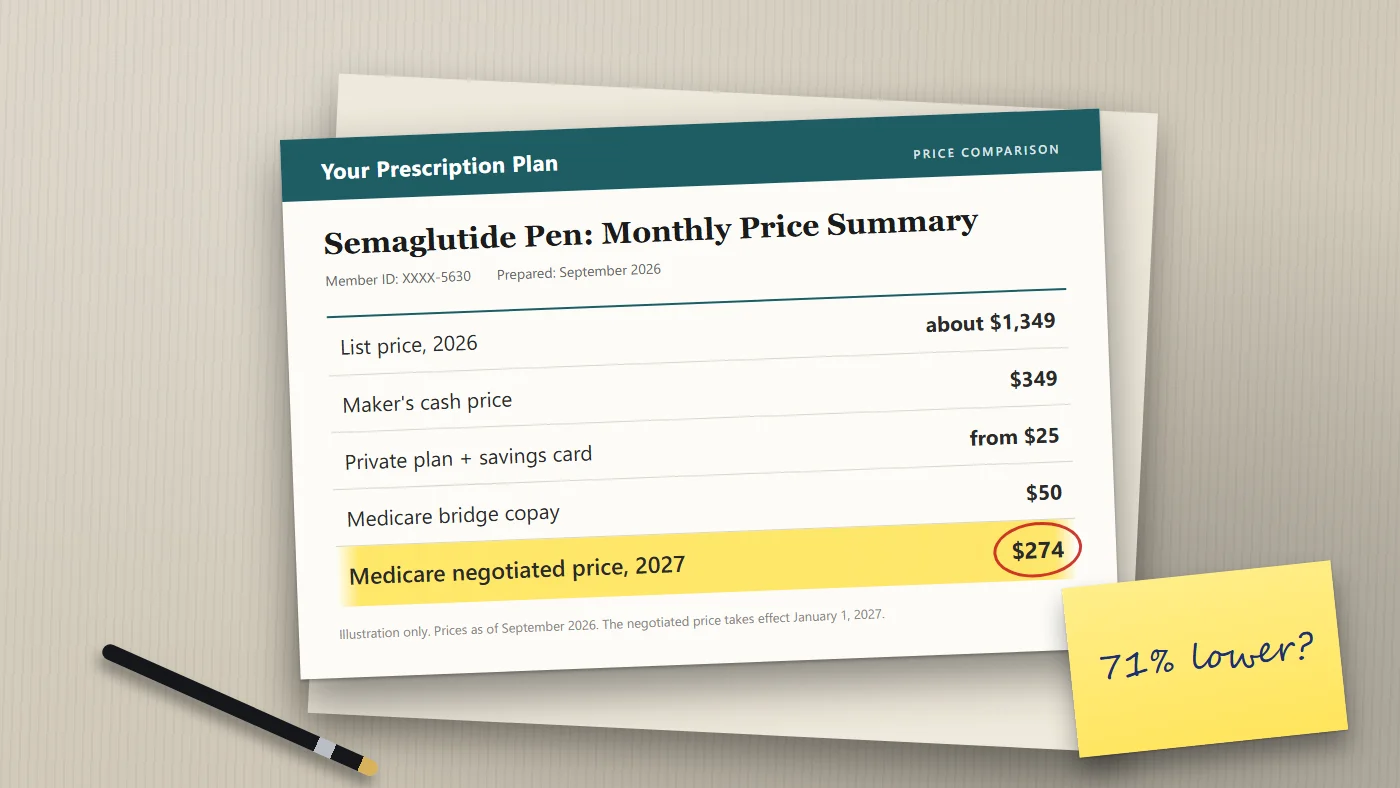
The list price gets the headlines. Wegovy lists at about $1,349 a month and Ozempic at about $1,028. Hardly anyone hands over that amount at the counter, but it still matters, because deductibles and coinsurance are often figured from it.
Then there's everything else. The maker's own cash price for most pens is $349 a month. A temporary Medicare program that started July 1, 2026, charges a flat $50 copay for Wegovy to people who meet its rules. And on January 1, 2027, a price Medicare negotiated for Ozempic, Wegovy and Rybelsus kicks in: $274 for a 30-day supply, 71% below the 2024 list price.
This piece covers those prices and nothing else. Taking either drug is a medical decision for you and your doctor. What follows is what each route costs, who's allowed to use it, and when the numbers change.
Why does one drug have so many prices?
A brand-name drug starts with a list price the manufacturer sets. Insurers then negotiate rebates off that number, privately. Medicare now negotiates some prices in public, under the 2022 Inflation Reduction Act, and since 2025 drug makers have been selling straight to patients who pay cash, at prices well under list.
Each channel lets in different people. A commercial plan might cover Ozempic for diabetes and turn down Wegovy for weight loss. Medicare Part D is barred by law from covering drugs used only for weight loss, though it can pay for the same molecule when it's prescribed for another approved use. So two neighbors with nearly identical prescriptions can pay $25 and $349 for the same box.
Lots of households are sorting through this. In a KFF poll from late 2025, 12% of adults, about one in eight, said they were taking a GLP-1 drug at the time. Another way to see it: 18% said they'd taken one at some point.
The five prices, side by side
Every figure below carries a date. These numbers moved several times in 2025 and 2026, and they'll move again on January 1, 2027.
| Route | Who can use it | Monthly price | As of |
|---|
| List price | The starting point for deductibles and coinsurance | About $1,349 Wegovy, about $1,028 Ozempic. The maker says all doses drop to $675 on January 1, 2027 | February 2026 announcement |
| Commercial insurance plus maker's savings card | People whose private plan covers the drug | As little as $25, with the card covering up to $100 a month | April 2026 price guide |
| Maker's cash price (self-pay) | People with a prescription who pay without insurance | $349 for most pens. $499 for the 2 mg Ozempic pen. $399 for the 7.2 mg Wegovy pen. Pills from $149 | April 2026 price guide, still posted September 2026 |
| Medicare GLP-1 Bridge | People in a Part D or Medicare Advantage drug plan who meet the weight and health criteria | $50 copay for Wegovy | July 1, 2026, through December 31, 2027 |
| Medicare negotiated price | People whose Part D plan covers the drug for an approved use | Plan's cost is based on $274 per 30-day supply. You pay your plan's share of that | Starts January 1, 2027 |
$274 a month. That's the price Medicare negotiated for a 30-day supply of Ozempic, Rybelsus and Wegovy, effective January 1, 2027. CMS puts it 71% below the 2024 list price of $959. About 2.28 million people in Part D used one of these drugs in 2024.
So is $274 what you'll pay? No. It's the price your Part D plan's costs are built on. Your share at the counter depends on the plan's deductible, which tier it puts the drug on, and how close you are to the yearly out-of-pocket cap. That cap is $2,100 in 2026 and rises to $2,400 in 2027, when the standard deductible also goes from $615 to $700. A lower base price usually shrinks your share, and it helps most if your plan charges a percentage rather than a flat copay.
It's also a 30-day figure, not a price per pen. CMS lists $276.78 for a single 4 mg/3 mL Ozempic pen, the same $276.78 for a 30-tablet bottle of 7 mg Rybelsus, and $385.63 for a box of four 2.4 mg Wegovy pens. Part D plans have to carry negotiated drugs on their formularies.
Your price comes down to your coverage, the diagnosis on the prescription, and the calendar. The sections below take each situation in turn, starting with Medicare, where a new program comes with more strings than most people expect.
Type 2 diabetes. Part D plans can cover Ozempic and the pill form for diabetes, often with prior authorization. From January 1, 2027, your share is based on the negotiated price.
Heart disease plus excess weight. Wegovy is approved for cutting the risk of heart attack and stroke in adults with established cardiovascular disease who also have obesity or are overweight. Part D plans may cover it for that use. Plans vary.
Weight management alone. By law, Part D can't cover it. The Medicare GLP-1 Bridge is the workaround. It began July 1, 2026, and runs through December 31, 2027. It covers Wegovy (pen or tablet), Zepbound in its KwikPen form, and a newer pill called Foundayo. Ozempic isn't on the list.
Medicare.gov says you may qualify if you're 18 or older, you're in a Part D plan or a Medicare Advantage plan with drug coverage, and you fit one of these groups:
- BMI of 35 or higher.
- BMI of 30 to 34.9 with at least one listed condition, such as uncontrolled high blood pressure, diastolic heart failure, or chronic kidney disease at stage 3a or later.
- BMI of 27 to 29.9 with at least one listed condition, such as prediabetes, a past heart attack or stroke, or peripheral artery disease with symptoms.
One exclusion trips people up. If you have type 2 diabetes, moderate-to-severe sleep apnea or fatty liver disease, or your Part D plan already covers a GLP-1 for you, the Bridge isn't your route. Your regular drug plan may cover it instead.
Your prescriber sends a prior authorization with the prescription and certifies that the drug is part of a diet-and-exercise program. Once it's approved, you pay $50 for each one-month supply.
Now the fine print on that $50. It doesn't count toward your Part D deductible or your yearly out-of-pocket cap, and Extra Help can't lower it. Over a full year that's $600 out of pocket.
The Bridge is temporary, too. CMS had planned a longer program, the BALANCE Model, to take over in Part D. On April 21, 2026, it said it wouldn't run BALANCE in Medicare Part D in 2027 and stretched the Bridge through the end of that year instead. Nobody has announced what happens to weight-loss coverage after December 31, 2027.
Insurance through work or the marketplace
Private plans are likelier to cover Ozempic for diabetes than Wegovy for weight loss. In KFF's 2025 employer survey, 43% of firms with 5,000 or more workers said they cover these drugs for weight loss, up from 28% a year earlier.
If your plan does cover the drug, the maker's savings card can get your copay down to as little as $25 a month. The card tops out at $100 a month in savings, so with a $200 plan copay you'd still owe $100. People on Medicare, Medicaid, TRICARE or VA coverage can't use it.
High deductible? Coinsurance? Then your cost tracks the list price, and that's the group Novo Nordisk says its 2027 cut is aimed at. On February 24, 2026, the company announced a $675 monthly list price for Wegovy, Ozempic and Rybelsus, all doses, starting January 1, 2027. Its self-pay prices don't change.
Say your plan charges 30% coinsurance on a drug that lists at $1,349. Your share runs about $405 a month. The same 30% on a $675 list price comes to about $203. If you're in that spot, the $349 cash price may beat your insurance until January, with one trade-off: cash you spend outside the plan usually doesn't count toward your deductible.
Paying cash
Novo Nordisk sells both drugs directly to cash payers with a valid prescription, by mail or local pharmacy pickup. Per its April 2026 price guide:
- Wegovy pen, 0.25 mg through 2.4 mg: $349 a month. The 7.2 mg Wegovy HD pen is $399.
- Wegovy pill: $149 for 1.5 mg, $199 for 4 mg, $299 for 9 mg or 25 mg.
- Ozempic pen: $349 a month for 0.25 mg, 0.5 mg or 1 mg, and $499 for 2 mg.
- Ozempic pill: from $149 a month, depending on dose.
- New patients: $199 a month for the first two fills of the 0.25 mg or 0.5 mg pen, through December 31, 2026.
TrumpRx.gov, the federal price site that went live on February 5, 2026, shows the same starting prices. Its $199 pen price is the new-patient rate, not what you'll pay once you move up a dose.
Doses usually climb over the first few months, so price the one you're expected to stay on.
What the FDA says about compounded versions
For roughly two years, compounded semaglutide sold widely through online clinics and med spas, because the brand-name drug was in shortage. The FDA declared the shortage resolved in February 2025, and the grace periods for compounders ran out that spring.
The agency doesn't mince words. Compounded drugs aren't FDA-approved, and the FDA doesn't review them for safety, effectiveness or quality before they're sold. As of May 31, 2026, it had received 990 adverse event reports tied to compounded semaglutide. It has also warned about products made with salt forms such as semaglutide sodium and semaglutide acetate, which are different active ingredients from the approved drug, and about counterfeit Ozempic pens turning up in the U.S. supply chain.
On April 30, 2026, the FDA proposed leaving semaglutide off the list of bulk ingredients that large outsourcing facilities may compound from. Comments closed June 29. We couldn't find a final decision as of this update.
"Generic Ozempic" doesn't exist. There's no FDA-approved generic of either drug in the U.S.
Check your own price in 30 minutes
- Find the reason on the prescription. Diabetes, heart risk or weight management: coverage turns on which one, so ask your prescriber's office what diagnosis they'll submit.
- Then the formulary. Jot down the drug's tier, whether it needs prior authorization, and whether you pay a flat copay or a percentage.
- Call the number on your insurance card and ask for two prices, this month's for a 30-day supply at your pharmacy and January's.
- On Medicare with a weight-management prescription? The GLP-1 Bridge starts with a prior authorization from your prescriber. Medicare.gov's weight loss drugs page lists the criteria.
- Price cash at the dose you'll stay on, and set it against a full year of your insurance cost, deductible included.
- Two dates for the calendar. December 31, 2026, is when the $199 new-patient offer is scheduled to end. January 1, 2027, brings the negotiated Medicare price and the lower list price.
- Denied? Appeal. Private plans and Part D plans both have a process for it.
Where comparing plans and providers pays off
Much of what you'll pay next year gets settled by two choices you make this fall.
Start with the drug plan, since it has a deadline. Medicare Open Enrollment runs October 15 through December 7. Every Part D plan has to carry the negotiated drugs in 2027, which doesn't make the plans interchangeable. Tiers still differ. So do deductibles and prior authorization rules, and once the new prices and the $2,400 cap are built in, this year's cheapest plan for you could land mid-pack. Give it an evening with the pharmacy label in front of you. If you take Ozempic for diabetes, enter that exact drug and dose in the Medicare Plan Finder and look at the full-year cost, not the premium. If you only make one call before December 7, I'd make it to confirm how your current plan will tier semaglutide in 2027.
The other choice is where the prescription comes from. Telehealth services and online weight management programs write a lot of these now, and some charge a monthly membership on top of the drug. Does that fee cover the medication, or just the visits? Is the drug the FDA-approved brand or a compounded product? Ask both before you sign up, and ask about cancellation fees.
Price whichever route you pick over twelve months. Then look hard at your first receipt in January: the $199 offer, the list price and the Medicare price are all scheduled to change by January 1, 2027.
This article is general information, not financial, legal, tax or medical advice.