The national median for an assisted living community hit $6,200 a month in CareScout's latest Cost of Care Survey, released in March 2026 with data collected in 2025. That's $74,400 a year, 5% more than the year before. Medicare won't pay it.
Most people don't want to move anyway. In AARP's 2024 Home and Community Preferences Survey, 75% of adults 50 and older said they'd like to stay in their current home as they age, and nearly half expected the house would need changes to make that work. Grab bars and easier entryways topped their list.
Behind a lot of those answers sits one fear, a fall. About one in four adults 65 and older reports falling each year, according to the CDC. Families usually look at the bathroom first. Then the stairs.
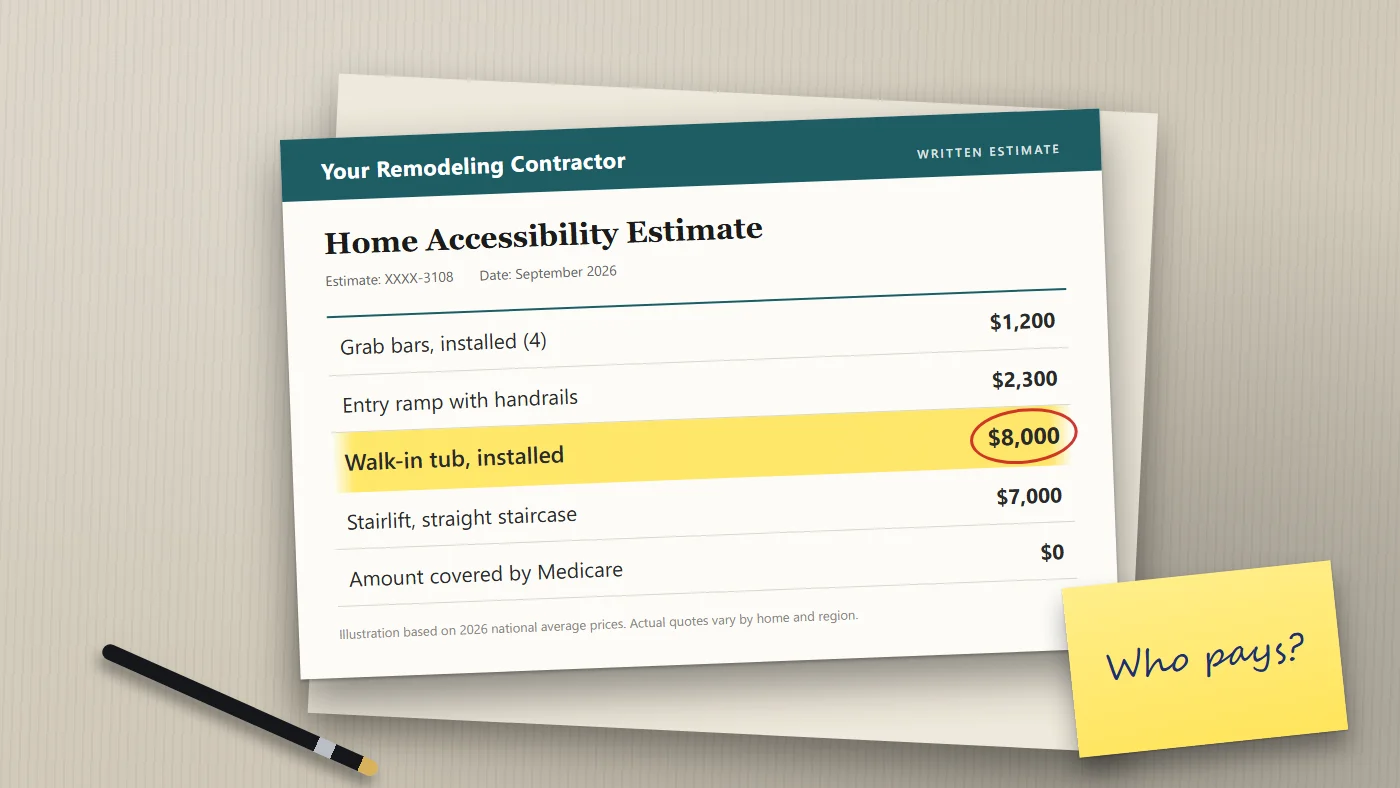
The fixes aren't free. A walk-in tub averages about $8,000 installed, a stairlift on a straight staircase runs about $7,000, and a curved one can cost nearly twice that. Medicare doesn't cover those either, which surprises plenty of people who assumed anything "medical" in the home would count.
So you're weighing a one-time bill against a monthly one that doesn't stop. Almost all of the one-time bill starts out as yours, though. Below are the real price ranges, followed by the handful of programs that can pick up part of it.
$6,200: one month of assisted living at the national median. A wheelchair ramp, four grab bars and a tub-to-shower conversion together average about $6,500, and you pay for them once.
What the common changes cost in 2026
These numbers come from Angi's 2026 cost guides, which are built from projects that homeowners and contractors report. Your own quote will depend on the house, the region and how much plumbing or framing is hiding behind the wall.
| Modification | Typical cost, installed | What moves the price |
|---|
| Grab bar | $200–$350 per bar | Wall reinforcement, tile, number of bars per visit |
| Wheelchair ramp | About $2,300 average; most pay $1,100–$3,600 | Length, material, handrails, permits |
| Tub-to-shower conversion | About $3,000 average; $1,500–$15,000 | Prefab stall or custom tile, hidden water damage |
| Walk-in tub | About $8,000 average; most pay $4,000–$15,000 | Jets, heated seat, door style, electrical and drain work |
| Stairlift, straight stairs | About $7,000 average | Rail length, seat type, new or reconditioned |
| Stairlift, curved stairs | About $13,000 average; $9,000–$30,000 | Custom-built rail, landings, turns |
Start at the top of the table. The cheapest items are also the ones AARP's respondents said they'd need most, and a set of four grab bars, put in by a handyman who knows to anchor them into studs or blocking instead of bare drywall, costs less than a single week of assisted living.
The bottom half is a different story. Walk-in tubs and curved stairlifts carry ranges so wide that two dealers can quote $4,000 and $15,000 for what looks like the same tub in the brochure. A curved rail is built for exactly one staircase, so it has almost no resale value, and quotes for it are all over the map.
Say you need the whole package: four grab bars at $300 apiece, a $3,000 tub-to-shower conversion, a $2,300 ramp and a $7,000 straight stairlift. That's about $13,500. Real money. It's also a little over two months of assisted living at the median.
Is staying home always the cheaper choice?
No. You should see why before you sign a remodeling contract.
A safer bathroom removes a fall hazard, but it doesn't replace a person. If you or a parent later need hands-on help with bathing, dressing or meals, that help costs money at home too, and the hours add up faster than most families expect. CareScout puts the national median for a non-medical in-home caregiver at $35 an hour. At 44 hours a week, the schedule CareScout uses for its annual figure, that's $80,080 a year. It's more than the assisted living median.
So the honest version goes like this. Modifications pay off best for people who are still independent and want to stay that way longer. They're a weaker bet once someone needs many hours of daily care. Most families land somewhere in between, and you're the one who knows where.
Timing matters too. The same AARP survey found that 44% of adults 50 and older expect to move at some point, with rising rent or mortgage costs the most common reason. If a move looks likely in the next couple of years, I'd spend on the cheap fixes and think hard before ordering a custom rail that can't come with you. A ramp and a walk-in tub stay behind when you sell. Whether the next buyer sees them as a plus is anyone's guess.
The price table also leaves out who pays. Families tend to assume Medicare covers "medical" equipment in the home, and a stairlift certainly feels medical. Medicare sees it another way, and the whole difference comes down to one definition.
The walker falls under Part B's durable medical equipment benefit, usually shortened to DME. A doctor prescribes it for use in your home, and once you've met the Part B deductible you pay 20% of the Medicare-approved amount, as long as the supplier accepts assignment. Wheelchairs, hospital beds, commode chairs and patient lifts sit on the same list. You could carry any of them out the front door.
A stairlift can't leave with you. Neither can a ramp, a walk-in tub, a widened doorway or a grab bar, so they count as home modifications. A doctor's letter calling the change medically necessary won't move it across that line under Original Medicare.
And Medicare Advantage? It's a little looser. Some plans add a small allowance for bathroom safety devices or cover an in-home safety assessment. It varies by plan and county, and your Evidence of Coverage will say. If that benefit would change your choice for 2027, open enrollment runs October 15 through December 7.
Programs that actually pay
Nobody signs you up for these automatically. A few phone calls before you pay full price are still the cheapest hour you'll spend on this project.
If you're on Medicaid, or close to it. Most states run home and community-based services waivers that can pay for what the rules call "environmental accessibility adaptations." In plain English, that's ramps, bathroom changes and similar work. You'll generally need to qualify for Medicaid financially, be assessed as needing a nursing-home level of care and then get a waiver slot.
That slot is where families get stuck. Each state sets its own dollar caps, contractor list and waiting list, and in some states the wait runs months or longer. What a neighbor got in Ohio tells you nothing about Arizona.
If you served. Ask the VA about Home Improvements and Structural Alterations, or HISA. It pays for roll-in showers, permanent ramps and wider doorways.
How much depends on your rating. Veterans who need the work for a service-connected condition, or who carry a service-connected rating of 50% or more, can get up to $6,800 over a lifetime. Other enrolled veterans can get up to $2,000.
Read the exclusions, though: the VA's own list rules out stair glides, porch lifts and portable ramps. You apply with VA Form 10-0103, a prescription from a VA clinician and a contractor's estimate.
A smaller group, veterans with certain severe service-connected disabilities, may qualify for far bigger grants. For fiscal year 2026 the Specially Adapted Housing grant tops out at $126,526. The Special Housing Adaptation grant's ceiling is $25,350.
If you live out in the country on a small income. USDA Rural Development runs the Section 504 repair program for homeowners in eligible rural areas whose income is very low. It lends up to $40,000 for repairs, at a fixed 1% rate.
Can't repay a loan at all? Homeowners 62 and older in that spot can apply for a grant of up to $10,000 to remove health and safety hazards. It comes with a string: sell the home within three years and you'll owe the grant back.
For everyone else, start local. Many Area Agencies on Aging run small repair and modification programs, funded by the Older Americans Act, local governments and nonprofits. The ones that don't usually know who does. You reach yours through the Eldercare Locator, which the federal Administration for Community Living runs, at 1-800-677-1116 or eldercare.acl.gov.
Then there's the tax return. IRS Publication 502 lets you count home improvements made mainly for medical care as medical expenses. Ramps, wider doorways, grab bars, railings and lifts generally count in full, since the IRS says they don't usually add to a home's value. An elevator is the classic exception. When an improvement does raise the value, you subtract that increase first.
Two limits stand in the way. You have to itemize on Schedule A, and only medical costs above 7.5% of your adjusted gross income are deductible.
Run it with an AGI of $60,000 and the floor comes out to $4,500. A $7,000 stairlift on top of a year's premiums and copays could clear it. A $300 grab bar won't. Not even close.
Pricing a walk-in tub or stairlift
Shop around here. Walk-in tubs, stairlifts and bath remodels for older adults are sold mostly through in-home sales visits, and the first number you hear often isn't the last one.
Dealers quote after they measure, so a firm price online is rare. Look up current ranges for your kind of staircase or tub, then get written quotes from several local installers for the same job, with the same questions for each. Is installation included, and who pulls the permit? What does the warranty cover on the motor, the door seal and the labor, and who services it locally? On a stairlift, find out whether they sell reconditioned units or rent them, and whether they'll buy it back later.
Reconditioned and rental units can cut the cost for a straight staircase. Buy-back matters because a straight rail can be reused; a curved one usually can't.
Get the plainer option priced, too. With a walk-in tub you still sit and wait while it fills, and again while it drains. A low-threshold walk-in shower with a seat and grab bars often costs less and suits more people, so have the installer quote both.
There's also a legal exit. The FTC's Cooling-Off Rule lets you cancel a contract over $25 signed during a sales visit at your home until midnight of the third business day, and the seller owes you two copies of a cancellation form. A "today only" price doesn't erase that right.
Steps to take, in order
Skip the showroom for now. The cheapest research you'll do is a lap around your own place with a pen. Front steps, the tub, the stairs. Is the bulb at the top of the stairs bright enough at 10 p.m.? Would a walker squeeze through the bathroom door? Jot it down. Some of it can wait. Some of it can't.
The can't-wait stuff is usually cheap stuff. Think grab bars and a second stair rail, maybe a shower seat and brighter light on the stairs. You're in the hundreds here, not the thousands.
Then work the phone:
- Call your doctor about a home safety evaluation, the kind an occupational therapist does, and ask your plan beforehand whether it pays.
- Try 1-800-677-1116. That's the Eldercare Locator. They'll hand you off to the Area Agency on Aging for your county, and those folks know what local help exists and how long the line is.
- Each program that fits you has its own door: your state Medicaid office for a waiver, your VA medical center's prosthetics department for HISA, your state USDA Rural Development office for Section 504.
Any job over $1,000 should get at least three written quotes for the same scope, all on paper. When one prices a shower conversion at $3,000 and another at $9,000, ask both why.
Don't sign on the first visit. Keep every invoice and the doctor's recommendation, since the medical expense deduction and any program that reimburses costs will ask for them.
Mistakes that cost the most
The most common one is buying the big item first. A family orders the $8,000 tub and skips the $300 grab bar next to the toilet, even though the hazards you meet every day are the ones to fix first.
Then there's counting on reimbursement later. Medicaid waivers, HISA and Section 504 generally need approval before the work starts. A job you've already paid for usually isn't eligible.
Who'll use the room in five years? A bathroom that works today but won't take a walker or wheelchair later may have to be torn out and redone. Ask about door widths and turning space now, while the walls are open.
If you make one call before any salesperson visits, make it 1-800-677-1116.
This article is general information, not financial, legal, tax or medical advice.