Here's a date worth circling if a Medicare drug plan fills any of your prescriptions: January 1, 2027. That morning, Medicare's price for 15 brand-name drugs drops, and for some of them it drops by more than half.
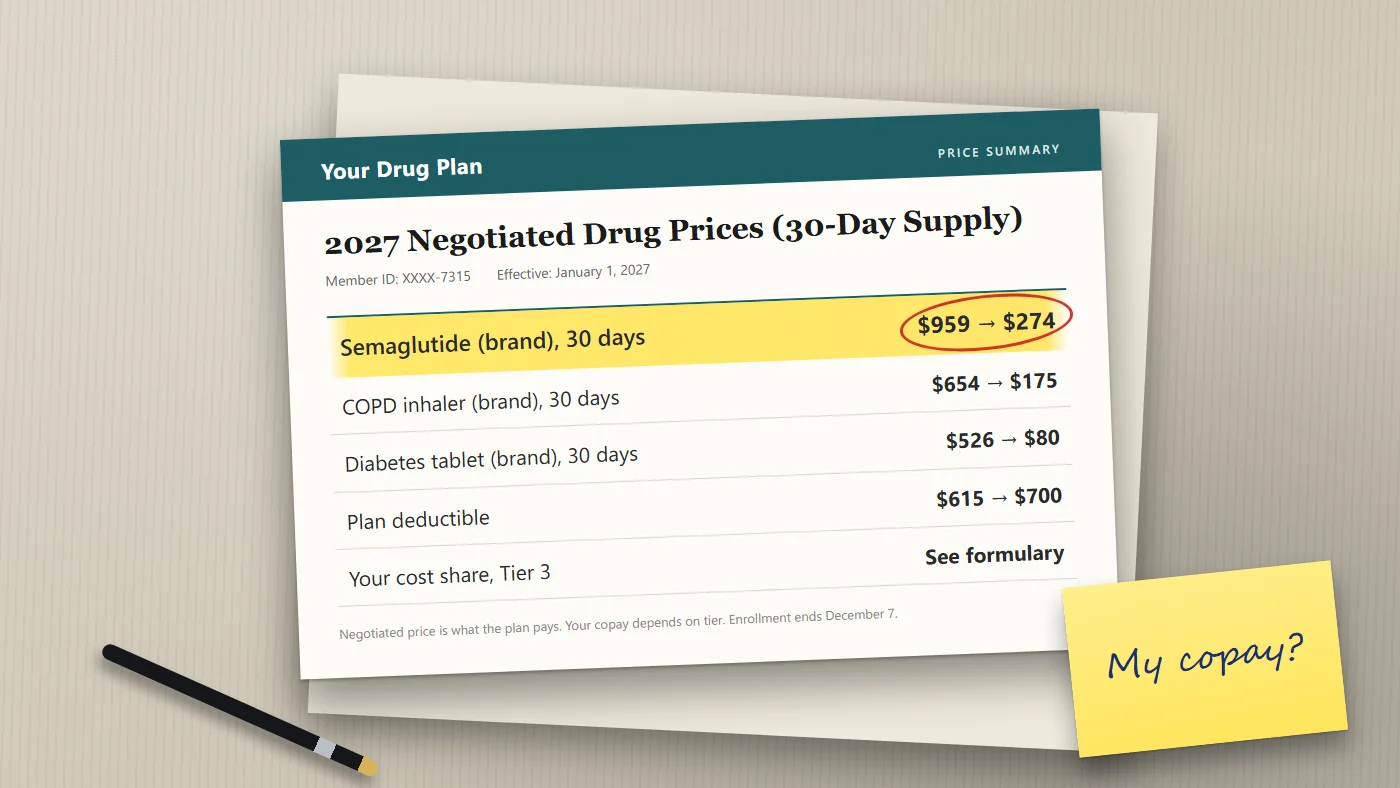
The one people ask about most is semaglutide. You know it as Ozempic, Rybelsus or Wegovy. In 2024 a month's supply listed at $959. Medicare's new price for that same month? $274.
These aren't estimates somebody floated. Medicare sat across the table from the drug makers and bargained, under powers Congress gave it in the Inflation Reduction Act, and the talks closed on November 1, 2025. The final prices went up later that month. Your plan doesn't get a vote, either. Every Part D plan, and every Medicare Advantage plan that covers drugs, has to carry all 15 in 2027.
Roughly 5.3 million people on Part D filled at least one of these drugs in 2024, by the count from the Centers for Medicare & Medicaid Services (CMS). If you're one of them, the obvious question is what happens at your pharmacy. Honest answer: it depends, and the piece that decides it isn't on Medicare's list. It's buried in your own plan's paperwork.
Think of it as two prices. There's what your plan pays for the drug, which is the number Medicare just negotiated. And there's what you pay, a copay or a percentage, which your plan picks on its own. Come January, some people will watch their monthly cost drop sharply. Others will hand over the same flat copay they paid in December.
The number to know: $959 down to $274, a 71% cut. That's a 30-day supply of Ozempic, Rybelsus or Wegovy, before and after negotiation. Across all 15 drugs, CMS expects people with Part D to save about $685 million out of pocket in 2027.
The full list: 15 drugs and their 2027 Medicare prices
Prices are for a 30-day supply. The list price column is the 2024 wholesale price CMS used as its starting point, and the last column shows how many Part D enrollees used each drug that year.
| Drug | Commonly used for | 2024 list price | 2027 Medicare price | Cut | Part D users, 2024 |
|---|
| Ozempic, Rybelsus, Wegovy | Type 2 diabetes; heart disease with obesity or overweight | $959 | $274 | 71% | 2,282,000 |
| Trelegy Ellipta | Asthma, COPD | $654 | $175 | 73% | 1,269,000 |
| Linzess | Chronic constipation, IBS-C | $539 | $136 | 75% | 632,000 |
| Breo Ellipta | Asthma, COPD | $397 | $67 | 83% | 626,000 |
| Tradjenta | Type 2 diabetes | $488 | $78 | 84% | 274,000 |
| Janumet, Janumet XR | Type 2 diabetes | $526 | $80 | 85% | 239,000 |
| Vraylar | Bipolar I, depression, schizophrenia | $1,376 | $770 | 44% | 118,000 |
| Xifaxan | IBS-D, hepatic encephalopathy | $2,696 | $1,000 | 63% | 105,000 |
| Xtandi | Prostate cancer | $13,480 | $7,004 | 48% | 35,000 |
| Otezla, Otezla XR | Psoriasis, psoriatic arthritis, Behçet's oral ulcers | $4,722 | $1,650 | 65% | 31,000 |
| Austedo, Austedo XR | Tardive dyskinesia, Huntington's chorea | $6,623 | $4,093 | 38% | 27,000 |
| Ofev | Idiopathic pulmonary fibrosis | $12,622 | $6,350 | 50% | 24,000 |
| Ibrance | Breast cancer | $15,741 | $7,871 | 50% | 16,000 |
| Calquence | Certain leukemias and lymphomas | $14,228 | $8,600 | 40% | 15,000 |
| Pomalyst | Multiple myeloma, Kaposi sarcoma | $21,744 | $8,650 | 60% | 14,000 |
This isn't small money. Part D spent about $42.5 billion on these 15 in 2024, close to 15% of everything it spent on drugs that year. People on Medicare paid $1.7 billion of that themselves. Now run the new prices back through 2024: after rebates, Medicare's bill would have come out roughly $12 billion lighter, by CMS's math.
Sound familiar? It's round two. The first ten negotiated drugs, Eliquis, Jardiance, Xarelto and Januvia among them, got their Medicare prices on January 1, 2026.
So will my copay actually go down?
Maybe. Your plan bills you for a drug in one of two ways. A copay is a flat amount, like $47 a fill. Coinsurance is a percentage of the drug's price, like 25%.
With coinsurance, a lower price flows straight through to you. Say your plan charges 25% on a brand-name drug. When the drug cost $959, your share came to about $240 a month. At $274, it's closer to $69. Real pharmacy prices don't always match list prices, so treat that as a sketch, but the direction holds.
A flat copay is another story. Your plan can keep charging you $47 in 2027 even though its own cost fell by hundreds of dollars. It could also cut the copay, raise it, or shuffle the drug to another tier. The law makes plans cover these 15 drugs. Where they sit on the tier ladder is left to the plan.
Then there's the deductible. Until you've cleared it, you pay the drug's full price at the counter, and on a standard plan that means the first $700 of 2027. This year it's $615. If you take Trelegy, "full price" used to mean several hundred dollars a month, and next year it means $175. Better, no question. The flip side: a $175 drug takes four months to work through a $700 deductible, unless your plan waives the deductible for that tier.
The specialty drugs are simpler. Xtandi, Ibrance, Calquence, Pomalyst, Ofev and Austedo still run somewhere between $4,000 and $8,700 a month after the cut. On a standard plan, that's enough to hit the 2027 out-of-pocket cap within the first month or two. The cap is $2,400, and past it you pay $0 for covered drugs. So the new price changes how fast you get there, not where you land.
One price cut, three very different outcomes. You won't know which one you've got until you look at your own plan's 2027 numbers, and you don't get long to do it.