Medicare
What Medicare Doesn't Cover: Dental, Vision, Hearing — and How Retirees Fill the Gap
Original Medicare pays $0 for routine dental work, eyeglasses and hearing aids. The options that fill the gap all have limits, and the limits are where the money goes.
 Margaret Linwood
Updated Sep 22, 2026 · 10 min read
Original Medicare will pay for heart surgery, cancer treatment and a week in the hospital. A cleaning, though? Nothing. The same goes for a filling, a crown, dentures, a routine eye exam, a pair of glasses or a hearing aid. Look any of those up on Medicare.gov and the answer comes back in one form or another: you pay all of it.
It catches people off guard every year. You may have paid the Medicare payroll tax through 40 years of work. Then the first big bill of retirement comes from a dentist, and Medicare isn't part of the conversation at all.
If that's you, you've got plenty of company. Nearly half of everyone on Medicare had no dental coverage of any kind when the health policy group KFF last took a detailed count, in 2019. That was 47%, or about 24 million people. Roughly the same share hadn't sat in a dentist's chair all year. And when people who went without needed dental, hearing or vision care were asked why, 70% pointed to the cost.
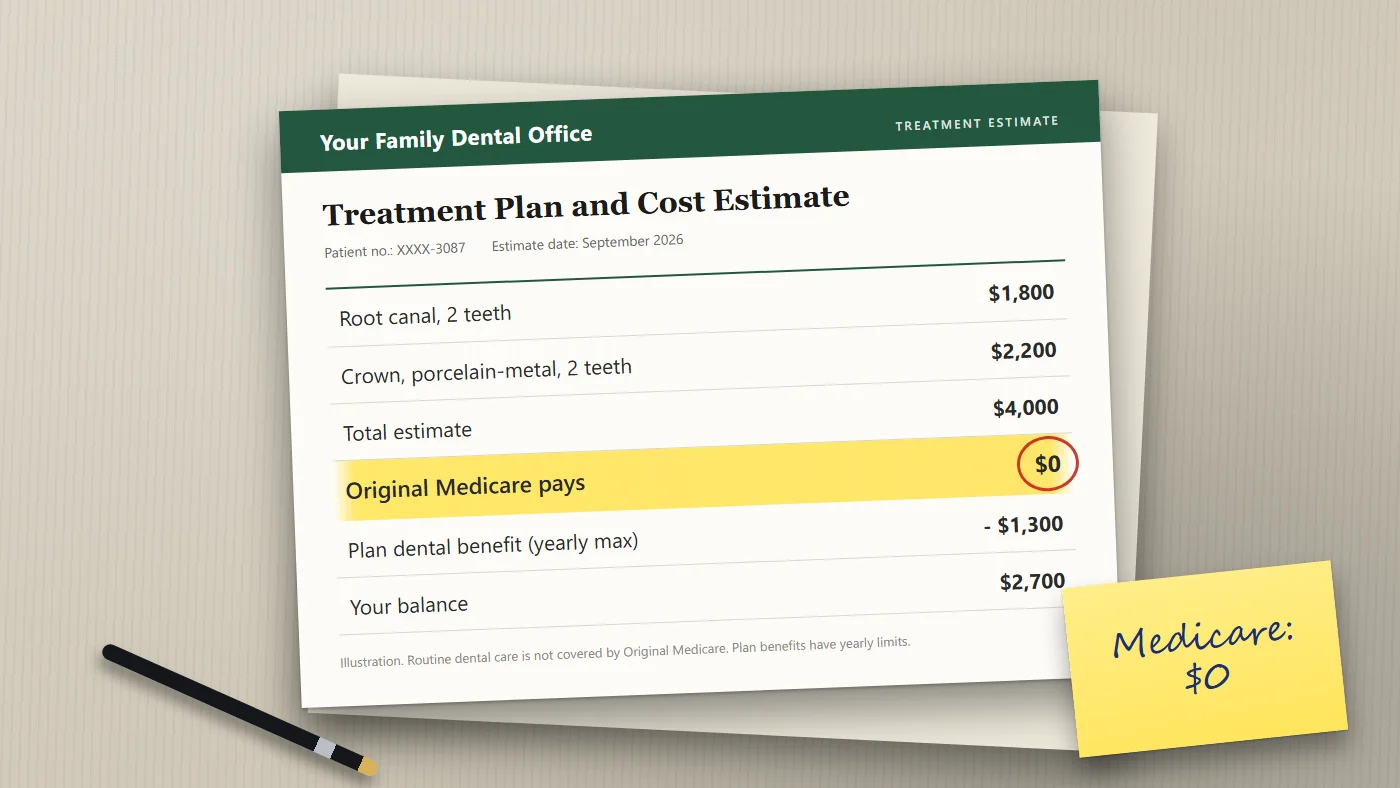
So put a price on it. Say you need a root canal and a crown on two teeth. The root canal alone can run $900 to $1,175, depending on the tooth. Then comes the crown, somewhere from $1,091 to $1,440 depending on what it's made of. (Those figures are Orlando, Florida prices from one large insurer's online cost tool.) Do it twice, once per tooth, and you're looking at something like $4,000 to $5,200. Your city and your dentist will push those numbers around. With Original Medicare alone, every dollar of it is yours.
The number to know: $0. Original Medicare pays nothing toward routine dental care, eyeglasses or hearing aids. So what do people end up spending? Among Medicare enrollees who used dental care, the average out-of-pocket bill for the year was $874. One in ten paid more than $2,000 (KFF, looking at 2018 data).
Teeth aren't even the most expensive per person. Hearing care came in higher in that same KFF analysis: $914 on average, for the people who paid for it. Vision was far lower, at $230.
What Medicare pays for, and the narrow exceptions
Why the hole? It was there on day one. When Medicare was created in 1965, routine dental, vision and hearing care didn't make it into the law, and in all the years since, Congress hasn't put them in.
| Service | What Original Medicare pays | The exception |
|---|
| Cleanings, fillings, extractions, crowns, dentures, implants | $0 | Dental care tied to certain covered treatment, such as an exam before a heart valve replacement or organ transplant, or treating a mouth infection before chemotherapy |
| Routine eye exams, eyeglasses, contact lenses | $0 | One pair of standard glasses or contacts after cataract surgery with a lens implant. You pay 20% after the Part B deductible |
| Hearing aids and fitting exams | $0 | Diagnostic hearing and balance exams are covered under Part B |
Eye disease is a different matter. Cataract surgery, glaucoma tests for people at high risk, yearly diabetic eye exams and treatment for macular degeneration all fall under Part B. What's excluded is the routine exam for glasses, and the glasses.
Doesn't Medigap fill that in? No. A Medicare Supplement policy pays your share of what Medicare covers, and when Medicare pays nothing, a standard Medigap plan pays nothing too. Some insurers sell dental or vision add-ons next to their Medigap policies, but that's a separate product with its own price tag.
Why "my plan includes dental" is only half an answer
If you do have this coverage, odds are it came with a Medicare Advantage plan. Nearly all of them offer something now. KFF's 2026 review of individual plans found some kind of dental benefit in 98% of them. Vision was even more common, at 99%, and hearing matched dental. Many of these plans don't cost you extra, either: two-thirds of the ones with drug coverage charge no premium beyond Part B.
Watch that word "some." Once KFF dug into plan details, using 2021 data, the limits looked like this:
- Dental: the plan's yearly payout topped out at about $1,300 on average. About 59% of enrollees had a cap of $1,000 or less. For major work, the most common cost share was 50%.
- Hearing: an average yearly limit of about $960, often one set of aids per year or every few years, through the plan's own supplier.
- Vision: about $160 a year toward eyewear, on average. For 45% of enrollees, the allowance was $100 or less.
Now run the $4,000 example through a plan like that. Paying 50% of major work, it would owe $2,000. The yearly cap stops it at $1,300, and you pay the other $2,700. That's real help. It just isn't what most people picture when an ad says dental is included.
And none of it is fixed. Say your dental cap is $2,000 in 2026; nothing stops the plan from making it $1,000 in 2027. You'd find out from the Annual Notice of Change, which your plan has to send by September 30.
The useful question, then, isn't "Do I have dental, vision or hearing coverage?" It's how many dollars that coverage pays in a year, for which services, at which offices. There are five common ways to get it, and each answers that question differently.