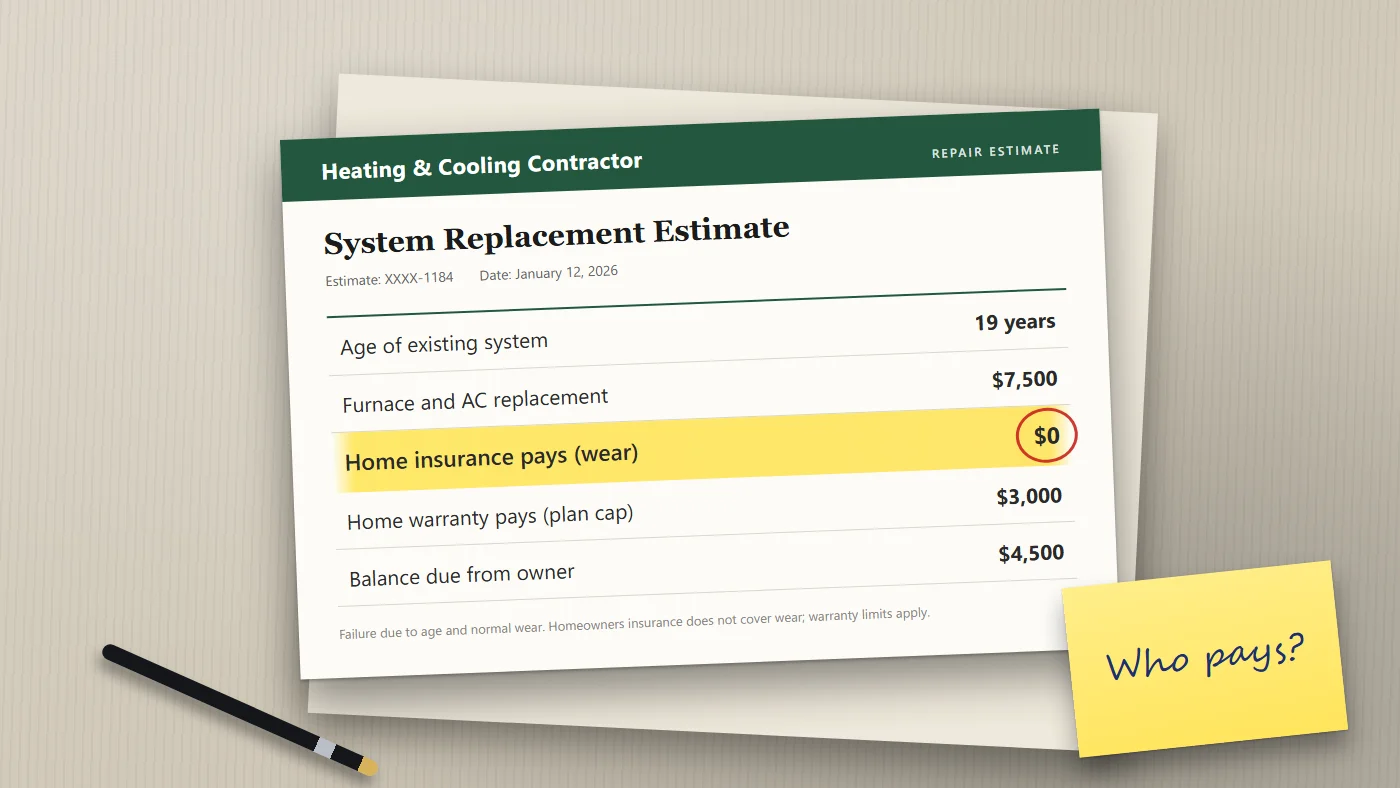
Picture a furnace that quits on a January night. The technician comes out the next morning, opens the cabinet and tells you the heat exchanger is cracked. The unit's 19 years old and not worth fixing. You need a new one, and you need it this week.
Plenty of homeowners make the same call next, to their home insurance company. The answer is no. Home insurance pays for sudden events like fire, wind, a falling tree or a burst pipe, and it doesn't pay for equipment that has simply reached the end of its life. The Insurance Information Institute says so directly: keeping up the home is your job, and a policy won't cover damage that comes from lack of maintenance.
So the bill is yours, and it isn't small. HomeAdvisor's 2026 cost data, updated in June, puts the average heating and cooling system replacement at about $7,500. Most homeowners pay between $5,000 and $12,500, and big or complicated jobs reach $22,000. An air conditioner alone runs $3,900 to $7,900. A gas furnace alone, $3,800 to $10,000. The water heater is the smaller cousin at $1,347 on average.
$7,500 is the average cost to replace a home heating and cooling system in 2026, according to HomeAdvisor. When the old system simply wears out, a standard home insurance policy pays $0 of it.
That gap is what home warranty companies sell against. For an average of $73 a month, or $876 a year, according to NerdWallet's 2026 survey of quotes from 19 companies, a home warranty promises to repair or replace major systems and appliances when they fail from normal use. Prices in that survey ran from $28 to $191 a month.
Is it a good trade? That comes down to three numbers buried in the contract: the payout cap, the service fee and the list of exclusions. The District of Columbia's attorney general gives a blunt example of the first one. Under a capped contract, the office warns, you may get only $1,600 toward replacing a $12,000 boiler.
What a home warranty actually is
The name's misleading. It isn't a warranty in the usual sense, since nobody is standing behind a product they built, and it isn't insurance either. The Federal Trade Commission calls these contracts on existing homes what they are: service contracts, sold separately, for an extra fee.
A typical contract runs one year and renews. You pay the annual or monthly price, and when something covered breaks, you call the warranty company rather than a repair shop. The company sends a contractor from its own network, and you pay a service fee for the visit, which NerdWallet found averages about $108. The contractor reports back. Then the company decides whether to repair, replace, offer cash or deny.
Notice who's making the decisions. You don't pick the contractor, the brand of the replacement or the timing. In July, with every technician in town booked solid, that matters.
Oversight is uneven, too. Depending on your state, these companies may answer to the insurance department, a licensing board, a real estate regulator or mostly to the attorney general's consumer protection office.
The numbers side by side
| Item | Typical 2026 figure | Source |
|---|
| Home warranty, per year | $876 average ($28 to $191 a month) | NerdWallet |
| Service fee, per visit | About $108 | NerdWallet |
| Replace full HVAC system | $7,500 average, $5,000 to $12,500 typical | HomeAdvisor |
| Replace AC unit only | $3,900 to $7,900 | HomeAdvisor |
| Replace gas furnace only | $3,800 to $10,000 | HomeAdvisor |
| Replace water heater | $1,347 average, $882 to $1,826 typical | HomeAdvisor |
Two things jump out. A water heater costs about what a year and a half of warranty payments does ($1,314), so a warranty bought mainly for the water heater rarely pays off. The heating and cooling system is the one item big enough to justify the contract, and that's why the cap on that line is the first number to find.
Where claims get denied
Complaints about home warranties follow a pattern, and consumer agencies keep flagging the same trouble spots.
Caps. The contract limits what the company pays per item and often per year. NerdWallet's illustration is a $2,000 repair against a $1,500 limit, which leaves you $500. On a bigger job the gap grows. If the cap were $3,000 and the job $7,500, the warranty would work exactly as written and you'd still owe $4,500.
Pre-existing conditions. Most contracts exclude problems that existed before coverage started, whether or not anyone knew about them.
Lack of maintenance. The company can ask for proof the system was serviced. No records often means no coverage.
Improper installation and code issues. If the old unit was installed wrong, or the new one needs upgrades to meet current code, those costs are commonly excluded. So are the extras around the job, like refrigerant, ductwork, permits, cranes and hauling the old unit away.
Repair instead of replace. The D.C. attorney general's office notes that a company may only repair a broken item rather than replace it, may limit replacements to a specific brand and your choice of contractor, and often makes you take several steps before it agrees to anything.
None of that makes the product a scam. It makes it a contract with limits, and the limits decide what it's worth. So before you pay for one, or renew the one you've got, run your own house through the math.